
Eriş, Engin Deniz
Loading...

Name Variants
Engin Deniz Eriş
Engin Deniz Eris
Engin Deniz Eris
Job Title
Prof.Dr.
Email Address
Main Affiliation
02.10. İşletme Mühendisliği Programları
Status
Current Staff
Website
ORCID ID
Scopus Author ID
Turkish CoHE Profile ID
Google Scholar ID
WoS Researcher ID
Sustainable Development Goals
 1
1NO POVERTY
0
Research Products
 2
2ZERO HUNGER
0
Research Products
 3
3GOOD HEALTH AND WELL-BEING
0
Research Products
 4
4QUALITY EDUCATION
0
Research Products
 5
5GENDER EQUALITY
0
Research Products
 6
6CLEAN WATER AND SANITATION
0
Research Products
 7
7AFFORDABLE AND CLEAN ENERGY
0
Research Products
 8
8DECENT WORK AND ECONOMIC GROWTH
0
Research Products
 9
9INDUSTRY, INNOVATION AND INFRASTRUCTURE
4
Research Products
 10
10REDUCED INEQUALITIES
0
Research Products
 11
11SUSTAINABLE CITIES AND COMMUNITIES
0
Research Products
 12
12RESPONSIBLE CONSUMPTION AND PRODUCTION
0
Research Products
 13
13CLIMATE ACTION
0
Research Products
 14
14LIFE BELOW WATER
0
Research Products
 15
15LIFE ON LAND
0
Research Products
 16
16PEACE, JUSTICE AND STRONG INSTITUTIONS
0
Research Products
 17
17PARTNERSHIPS FOR THE GOALS
1
Research Products

This researcher does not have a Scopus ID.

Documents
6
Citations
36

Scholarly Output
8
Articles
8
Views / Downloads
0/0
Supervised MSc Theses
0
Supervised PhD Theses
0
WoS Citation Count
35
Scopus Citation Count
52
Patents
0
Projects
0
WoS Citations per Publication
4.38
Scopus Citations per Publication
6.50
Open Access Source
1
Supervised Theses
0
| Journal | Count |
|---|---|
| International Journal of Gastronomy and Food Science | 2 |
| International Journal of Tourism Cities | 2 |
| Journal of Family Business Management | 2 |
| Tourism: An International Interdisciplinary Journal | 2 |
Current Page: 1 / 1
Scopus Quartile Distribution
Quartile distribution chart data is not available
Competency Cloud
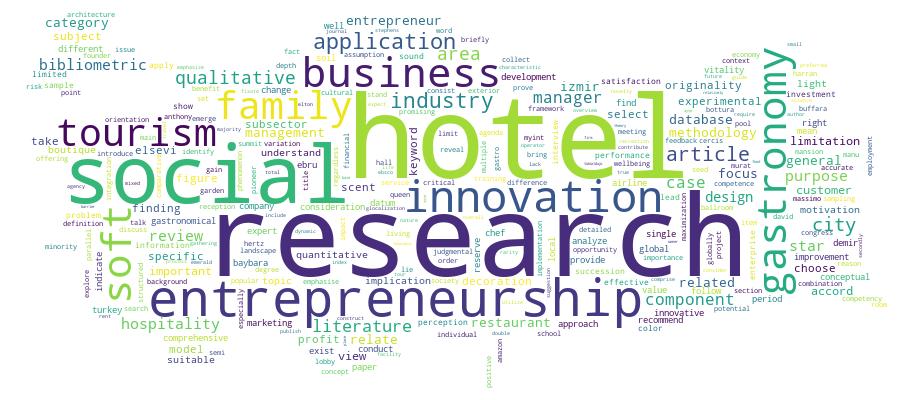
8 results
Scholarly Output Search Results
Now showing 1 - 8 of 8
Article Family businesses in the tourism industry: a research agenda(Emerald Publishing, 2022) Ozan Altin; Ige Pirnar; Engin Deniz Eriş; Ebru Gunlu-KucukaltanPurpose: The purpose of this study is to construct a comprehensive review on family businesses in the tourism industry since glocalization and small businesses comprise most of the industry. Design/methodology/approach: This is a conceptual paper which utilizes qualitative research methods. Bibliometric analysis is applied to the selected 35 articles from specific databases which include not only the general tourism industry but also subsectors of airline hospitality restaurant etc. Articles in this study fixate on the family businesses within the tourism industry. Findings: In total 35 articles are found with the keywords “family business and tourism” “family business and hospitality and hotels” “family business and restaurant” and “family business and airline”. Though the family business studies focus on hospitality tourism and restaurants as F&B there is a research gap in the subsectors like rent-a-car companies travel agencies and tour operators and recreation facilities. Overall qualitative research design is preferred but majority of the authors’ focus is on business development profit performance and succession. For further studies quantitative analysis on research gap areas are recommended. Research limitations/implications: The most general limitation is that only specific selected databases are used for the data gathering process such as double reviewed indexed journals published within Web of Science Emerald Elton B. Stephens Company (EBSCO) and Elsevier databases from the period of 1970s. Some other databases and some different periods may be considered as well as different keywords for other research. Secondly few studies have analyzed quantitative data since the specific nature of the family business dynamics require qualitative data. As a suggestion not only qualitative analysis but also mixed methods may also be studied since the literature lacks the studies conducted with these methodologies. Originality/value: The study contributes to the existing literature by providing a comprehensive review on hospitality and tourism family business management emphasizing the research gap on subsector application areas. © 2022 Elsevier B.V. All rights reserved.Article Bibliometric analysis of social entrepreneurship in gastronomy tourism(INST TOURISM, 2020) Duygu Celebi; Ige Pirnar; Engin Deniz ErisThe definition of entrepreneurship briefly stands for setting up a new business by taking financial and other risks to gain profits. Phenomenon of social entrepreneurship has emerged as a follow up concept of entrepreneurship as a critical issue in the context of both improvement and wellbeing of societies. Social entrepreneurship focuses on social problems rather than profit maximization and is especially important for gastronomy tourism due to the social local benefits as cultural integration and employment it brings. In order to understand the promising research areas and explore the research gap in the gastronomical social entrepreneurship applications bibliometric analysis is chosen since studies are limited in the gastronomy tourism as well as social entrepreneurship. The research in subject area consisted on keywords that are used as search items for articles title section to select articles that are more accurate for the aim of the research. The analysis shows that there are 20 articles with the combination of related key word variations. When the methodologies of the related articles is analyzed it is understood that qualitative research with multiple and comparative case study is chosen for almost all the related articles. The reason might be due to the characteristics of the research topic and novelty thus rarity of true to life gastronomical social innovation applications. This study is expected to guide future studies by providing general overview of the studies and the research gap in social entrepreneurship and gastronomy tourism.Article Citation - WoS: 3Citation - Scopus: 5Experimental social entrepreneurship model in gastronomy: The case of Ebru Baybara Demir as a social gastronomy entrepreneur(AZTI-Tecnalia, 2022) Engin Deniz Eriş; Ige Pirnar; Duygu Çelebi; Eris, Engin Deniz; Pirnar, Ige; Celebi, DuyguGastronomy industry is very suitable for social entrepreneurship applications and global pioneers like Anthony Myint David Hertz Manu Buffara Massimo Bottura and Ayşe Tükürükçü prove this fact. The purpose of the study is to emphasise the importance and the training opportunities of minorities of social entrepreneurship in gastronomy industry and figure out the motivations and related competencies since there is a gap in the related literature. Hence conceptual framework of social gastronomy entrepreneurship is introduced and a single case study designed with the Experimental Social Entrepreneurship Model for Individuals is discussed where results indicate that the competence background of the research subject and main assumptions are in parallel with the entrepreneur orientation literature. Globally popular Ebru Baybara Demir who is the only social gastronomy entrepreneurship chef in Turkey is chosen as a single case research study subject since she is the founder of many innovative projects like The Cercis Murat Mansion Harran Gastronomy School Living Soil Local Seed Let's Talk Soil Amazon Queens Global Gastro Economy Summit. © 2022 Elsevier B.V. All rights reserved.Article Citation - WoS: 4Citation - Scopus: 7Soft innovation in hotel services: case of Izmir City(Emerald Group Holdings Ltd., 2020) Ige Pirnar; Yasemin Celik Kamali; Engin Deniz Eriş; Eris, Engin Deniz; Pirnar, Ige; Kamali, Yasemin CelikPurpose: The purpose of this paper is to figure out the impacts of soft innovation in the city hotels in general whereas the focus is on figuring out if there exists a difference in vitality on the components of soft innovation among the hotel categories as 4 stars 5 stars and boutique hotels in Izmir Turkey. Design/methodology/approach: The first part is related to a detailed literature review on the soft innovation components as color sound light scent and decoration. Literature review is followed by a qualitative research where expert information on the research topic is collected. Judgmental sampling is used to identify experts’ views where in-depth semi-structured interviews are conducted with 12 hotel managers in Izmir city. The soft innovation hotel application areas taken into consideration are: lobby and reception rooms restaurant bar and ballroom areas meeting and congress halls SPA and pools gardens and landscape and other exterior hotel architecture. Findings: The findings of the research reveal the sample hotel managers’ views as all the soft innovation applications are important for all city hotels regardless of their category meaning that soft innovation may lead to better marketing results. Thus according to hotel managers soft innovation offerings have a potential for better customer satisfaction as positive feedback. However the vitality degree among components changes according to the hotel’s category. For boutique hotels the most important component is found to be the decoration of the hotel whereas for 4 stars hotels it is light and for 5 stars hotels it is scent. Research limitations/implications: The results of this study give relatively limited information because only managers’ point of view are shown. In the research customers’ perceptions on soft innovation based interviews with the top management of the hotels studied takes place indicating which may not be the case to reflect the real perception of customers. Therefore for further researches it is recommended for the other researches to take into consideration of customers’ point of views as well. Also time limitation sample size and application of only qualitative research may be stated as the limitations for this study. Quantitative research applies to customers on the same topic and problem statement is recommended for further studies related to city hotels’ soft innovation applications. Practical implications: Motivation of this study is to understand how soft innovation can change hotels’ atmosphere and make it more attractive from the managers’ perceptions. According to hotel managers’ views soft innovation applications may lead to higher customer satisfaction but the level of investment among the components may change according to the city hotel’s category. Research implications indicate that hotel managers may optimize the effectiveness of their soft innovation efforts by taking into consideration their hotel type application areas and innovation category as decoration color scent sound and light. According to hotel managers decoration-related soft innovation is more important to boutique hotels lighting-related soft innovation is an effective investment for 4 stars hotels and scent-related soft innovation is a suitable investment for 5 stars hotels. Originality/value: The originality of the study lies in the analysis of the components of soft innovation as a means for effective city hotel marketing and innovative management applications. Though it is a very suitable industry for implementation improvement and development there are limited studies on soft innovation applications in the hotel industry. © 2021 Elsevier B.V. All rights reserved.Article Citation - WoS: 8Citation - Scopus: 8Family businesses in the tourism industry: a research agenda(EMERALD GROUP PUBLISHING LTD, 2022) Huseyin Ozan Altin; Ige Pirnar; Engin Deniz Eris; Ebru Gunlu; Altin, Huseyin Ozan; Eris, Engin Deniz; Gunlu, Ebru; Pirnar, IgePurpose The purpose of this study is to construct a comprehensive review on family businesses in the tourism industry since glocalization and small businesses comprise most of the industry. Design/methodology/approach This is a conceptual paper which utilizes qualitative research methods. Bibliometric analysis is applied to the selected 35 articles from specific databases which include not only the general tourism industry but also subsectors of airline hospitality restaurant etc. Articles in this study fixate on the family businesses within the tourism industry. Findings In total 35 articles are found with the keywords family business and tourism family business and hospitality and hotels family business and restaurant and family business and airline. Though the family business studies focus on hospitality tourism and restaurants as F&B there is a research gap in the subsectors like rent-a-car companies travel agencies and tour operators and recreation facilities. Overall qualitative research design is preferred but majority of the authors' focus is on business development profit performance and succession. For further studies quantitative analysis on research gap areas are recommended. Research limitations/implications The most general limitation is that only specific selected databases are used for the data gathering process such as double reviewed indexed journals published within Web of Science Emerald Elton B. Stephens Company (EBSCO) and Elsevier databases from the period of 1970s. Some other databases and some different periods may be considered as well as different keywords for other research. Secondly few studies have analyzed quantitative data since the specific nature of the family business dynamics require qualitative data. As a suggestion not only qualitative analysis but also mixed methods may also be studied since the literature lacks the studies conducted with these methodologies. Originality/value The study contributes to the existing literature by providing a comprehensive review on hospitality and tourism family business management emphasizing the research gap on subsector application areas.Article Soft innovation in hotel services: case of Izmir City(EMERALD GROUP PUBLISHING LTD, 2020) Ige Pirnar; Yasemin Celik Kamali; Engin Deniz ErisPurpose The purpose of this paper is to figure out the impacts of soft innovation in the city hotels in general whereas the focus is on figuring out if there exists a difference in vitality on the components of soft innovation among the hotel categories as 4 stars 5 stars and boutique hotels in Izmir Turkey. Design/methodology/approach The first part is related to a detailed literature review on the soft innovation components as color sound light scent and decoration. Literature review is followed by a qualitative research where expert information on the research topic is collected. Judgmental sampling is used to identify experts' views where in-depth semi-structured interviews are conducted with 12 hotel managers in Izmir city. The soft innovation hotel application areas taken into consideration are: lobby and reception rooms restaurant bar and ballroom areas meeting and congress halls SPA and pools gardens and landscape and other exterior hotel architecture. Findings The findings of the research reveal the sample hotel managers' views as all the soft innovation applications are important for all city hotels regardless of their category meaning that soft innovation may lead to better marketing results. Thus according to hotel managers soft innovation offerings have a potential for better customer satisfaction as positive feedback. However the vitality degree among components changes according to the hotel's category. For boutique hotels the most important component is found to be the decoration of the hotel whereas for 4 stars hotels it is light and for 5 stars hotels it is scent. Originality/value The originality of the study lies in the analysis of the components of soft innovation as a means for effective city hotel marketing and innovative management applications. Though it is a very suitable industry for implementation improvement and development there are limited studies on soft innovation applications in the hotel industry.Article Citation - WoS: 20Citation - Scopus: 32Bibliometric analysis of social entrepreneurship in gastronomy tourism(Institute for Tourism tourism@iztzg.hr, 2020) Duygu Çelebi; Ige Pirnar; Engin Deniz Eriş; Eris, Engin Deniz; Pirnar, Ige; Celebi, DuyguThe definition of "entrepreneurship" briefly stands for setting up a new business by taking financial and other risks to gain profits. Phenomenon of "social entrepreneurship" has emerged as a follow up concept of entrepreneurship as a critical issue in the context of both improvement and wellbeing of societies. Social entrepreneurship focuses on social problems rather than profit maximization and is especially important for gastronomy tourism due to the social local benefits as cultural integration and employment it brings. In order to understand the promising research areas and explore the research gap in the gastronomical social entrepreneurship applications bibliometric analysis is chosen since studies are limited in the gastronomy tourism as well as social entrepreneurship. The research in subject area consisted on keywords that are used as search items for articles title section to select articles that are more accurate for the aim of the research. The analysis shows that there are 20 articles with the combination of related key word variations. When the methodologies of the related articles is analyzed it is understood that qualitative research with multiple and comparative case study is chosen for almost all the related articles. The reason might be due to the characteristics of the research topic and novelty thus rarity of true to life gastronomical social innovation applications. Th is study is expected to guide future studies by providing general overview of the studies and the research gap in social entrepreneurship and gastronomy tourism. © 2020 Elsevier B.V. All rights reserved.Article Experimental social entrepreneurship model in gastronomy: The case of Ebru Baybara Demir as a social gastronomy entrepreneur(ELSEVIER, 2022) Engin Deniz Eris; Ige Pirnar; Duygu CelebiGastronomy industry is very suitable for social entrepreneurship applications and global pioneers like Anthony Myint David Hertz Manu Buffara Massimo Bottura and Ayse Tukurukcu prove this fact. The purpose of the study is to emphasise the importance and the training opportunities of minorities of social entrepreneurship in gastronomy industry and figure out the motivations and related competencies since there is a gap in the related literature. Hence conceptual framework of social gastronomy entrepreneurship is introduced and a single case study designed with the Experimental Social Entrepreneurship Model for Individuals is discussed where results indicate that the competence background of the research subject and main assumptions are in parallel with the entrepreneur orientation literature. Globally popular Ebru Baybara Demir who is the only social gastronomy entrepreneurship chef in Turkey is chosen as a single case research study subject since she is the founder of many innovative projects like The Cercis Murat Mansion Harran Gastronomy School Living Soil Local Seed Let's Talk Soil Amazon Queens Global Gastro Economy Summit.
