Köksal İncirlioğlu, Füsun

Loading...
Profile Picture
Name Variants
FÜsun Köksal İncirlioǧlu
Job Title
Doç.Dr.
Email Address
Main Affiliation
01.01.08.03. Müzik Bölümü
Status
Current Staff
Website
Scopus Author ID
Turkish CoHE Profile ID
Google Scholar ID
WoS Researcher ID

Sustainable Development Goals

SDG data is not available
Documents

1

Citations

0

h-index

0

This researcher does not have a WoS ID.
Scholarly Output

2

Articles

2

Views / Downloads

0/0

Supervised MSc Theses

0

Supervised PhD Theses

0

WoS Citation Count

0

Scopus Citation Count

0

Patents

0

Projects

0

WoS Citations per Publication

0.00

Scopus Citations per Publication

0.00

Open Access Source

1

Supervised Theses

0

JournalCount
Tempo1
Yegah Musicology Journal1
Current Page: 1 / 1

Scopus Quartile Distribution

Quartile distribution chart data is not available

Competency Cloud

GCRIS Competency Cloud

Scholarly Output Search Results

Now showing 1 - 2 of 2
  • Article
    REPETITIVE MODELS in TWENTY-FIRST-CENTURY MUSIC: TEMPORALITY and EXPRESSION
    (Cambridge University Press, 2025) FÜsun Köksal İncirlioǧlu; İncirlioǧlu, FÜsun Köksal
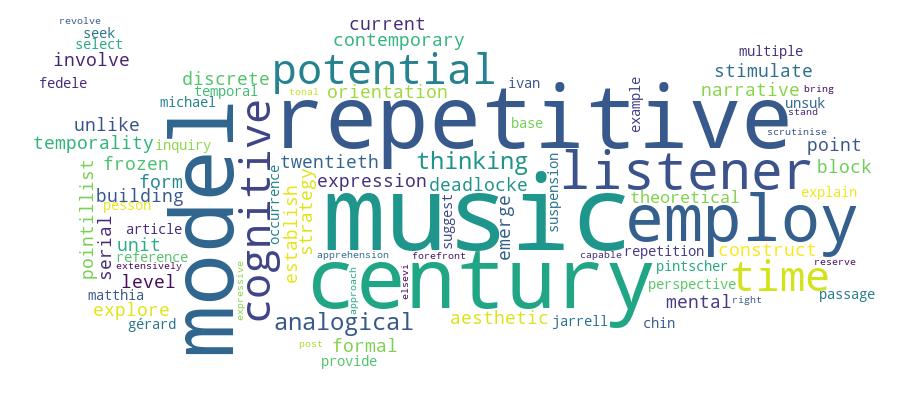
    Unlike the pointillist-serial aesthetics of the mid-twentieth century contemporary music employs narrative strategies that stimulate listeners to form mental constructs. This involves using the potential of mid-level formal units to establish orientation points for the listener exploring two repetitive models (deadlocked time and frozen time) that emerge as discrete building blocks from the current cognitive-theoretical perspective. Through analogical thinking this article seeks to explain the potential references of these repetition-occurrences towards a temporal suspension and provides multiple examples based on selected passages from Ivan Fedele (b. 1953) Matthias Pintscher (b. 1971) Gérard Pesson (b. 1958) Unsuk Chin (b. 1961) and Michael Jarrell (b. 1958). This inquiry suggests an apprehension capable of bringing an expressive stand to the forefront. It also scrutinises how cognitive approaches revolving around analogical thinking can be employed extensively in the analysis of post-tonal music. © 2025 Elsevier B.V. All rights reserved.