
Rana, Tohid Ahmed
Loading...
Name Variants
Tohid Ahmed Rana
Job Title
Öğrt.Gör.
Email Address
Main Affiliation
01.01.13.05. Bilgisayar Programcılığı Programı
Status
Current Staff
Website
ORCID ID
Scopus Author ID
Turkish CoHE Profile ID
Google Scholar ID
WoS Researcher ID
Sustainable Development Goals
 1
1NO POVERTY
0
Research Products
 2
2ZERO HUNGER
0
Research Products
 3
3GOOD HEALTH AND WELL-BEING
0
Research Products
 4
4QUALITY EDUCATION
8
Research Products
 5
5GENDER EQUALITY
0
Research Products
 6
6CLEAN WATER AND SANITATION
0
Research Products
 7
7AFFORDABLE AND CLEAN ENERGY
0
Research Products
 8
8DECENT WORK AND ECONOMIC GROWTH
0
Research Products
 9
9INDUSTRY, INNOVATION AND INFRASTRUCTURE
0
Research Products
 10
10REDUCED INEQUALITIES
0
Research Products
 11
11SUSTAINABLE CITIES AND COMMUNITIES
0
Research Products
 12
12RESPONSIBLE CONSUMPTION AND PRODUCTION
0
Research Products
 13
13CLIMATE ACTION
0
Research Products
 14
14LIFE BELOW WATER
0
Research Products
 15
15LIFE ON LAND
0
Research Products
 16
16PEACE, JUSTICE AND STRONG INSTITUTIONS
3
Research Products
 17
17PARTNERSHIPS FOR THE GOALS
0
Research Products

Documents
8
Citations
12
h-index
2

Documents
5
Citations
2

Scholarly Output
15
Articles
0
Views / Downloads
0/0
Supervised MSc Theses
0
Supervised PhD Theses
0
WoS Citation Count
11
Scopus Citation Count
12
Patents
0
Projects
0
WoS Citations per Publication
0.73
Scopus Citations per Publication
0.80
Open Access Source
0
Supervised Theses
0
| Journal | Count |
|---|---|
| 13th European Conference on e-Learning ECEL 2014 | 2 |
| 13th European Conference on e-Learning (ECEL) | 2 |
| 12th European Conference on eGovernment (ECEG) | 2 |
| 14th European Conference on Cyber Warfare and Security ECCWS 2015 | 1 |
| 14th European Conference on E-Learning (ECEL) | 1 |
Current Page: 1 / 3
Scopus Quartile Distribution
Quartile distribution chart data is not available
Competency Cloud
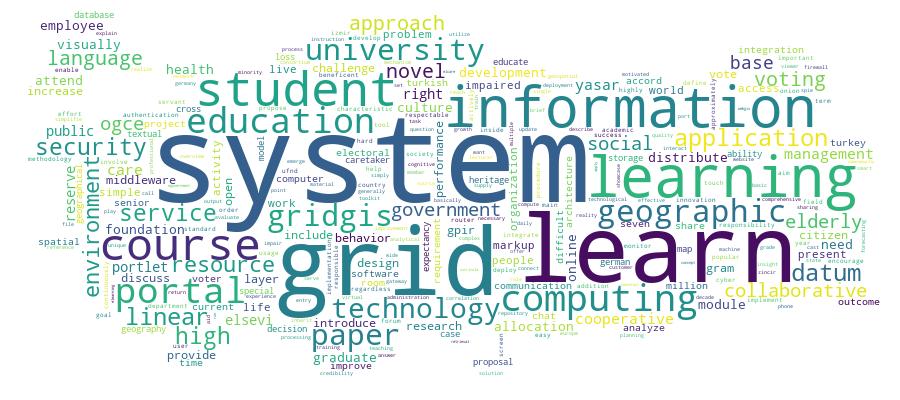
15 results
Scholarly Output Search Results
Now showing 1 - 10 of 15
Conference Object Research on the middleware of grid GIS - Distributed cooperative computing GIS software and its key technologies(SPIE-INT Soc Optical Engineering, 2007) Yumei Sun; Yu Fang; Bin M. Chen; Tohid Ahmed Rana; Sun, Yumei; Chen, Bin; Rana, Tohid Ahmed; Fang, YuThis paper introduces the concept of grid computing and its characteristics. Basing on analyzing the characteristics of grid computing we apply grid computing to GIS field to construct grid GIS which is the application of grid computing on geographic information system with grid computing as the basic running environment. According to the architecture of grid and integrating the characteristics of GIS we design the architecture of grid GIS which has three layers. They are grid GIS resource layer grid GIS middleware layer and grid GIS application layer. Among them the grid GIS middleware layer is the most important. Then this paper expatiates on our research on grid GIS middleware which is about the design and development of distributed cooperative computing GIS software. The key technologies of the distributed cooperative computing GIS software are discussed which include technology of global spatial resource management spatial data computing task allocation and management system consistency mechanism and system security mechanism. The implementation process is also presented. At last this paper presents the further researches of the distributed cooperative computing GIS software. © 2008 Elsevier B.V. All rights reserved.Conference Object The security and the credibility challenges in E-voting systems(Curran Associates Inc., 2015) Tohid Ahmed Rana; Ibrahim Zincir; Samsun Mustafa Basarici; N. AbouzakharE-voting is one of the most emerging social innovations of the 21st century which is being adopted by many countries since it represents the peak of e-government solutions and also enables an easier way to vote for their citizens and expatriates. In addition e-voting systems will not only increase the amount of voters' participation but also will decrease the total cost of electoral process. The main concern with the e-voting system is security. Unlike any other offence it is first difficult to observe ambiguities in voting and also it is much more difficult to locate the lost or to detect the rigged votes. Challenges such as how to authenticate the voter how to securely cast his/her vote and then how to store and to count these votes without outside influence generate whole scrutiny over the e-voting systems. This paper first discusses these challenges and then proposes a unique approach to ensure public confidence and credibility over the electoral systems. This proposal inherits 2 independent modules, first module to verify authentication by implementing an e-government application and smartphone to identify a registered voter. After the completion of successful validation the second module that provides anonymity to the voter similar to TOR (The Onion Router) will be activated to cast the e-ballot. © 2023 Elsevier B.V. All rights reserved.Conference Object Citation - WoS: 2Citation - Scopus: 2A Proposal for a Novel e-Learning System for the Visually Impaired(ACAD CONFERENCES LTD, 2014) Ahmed Rana; Ibrahim Zincir; Samsun Basarici; Basarici, Samsun; Rana, Ahmed; Zincir, Ibrahim; R Orngreen; KT LevinsenAccording to World Health Organization (WHO) 285 million people are estimated to be visually impaired worldwide: 39 million are blind and 246 million have low vision. It is a well-known fact that for the visually impaired it is not possible to access the information via drawings and figures as there is no interpretation. In addition it is not easy to search through a passage for the relevant information as Braille takes much more time to read and finally a lot of memorization is necessary in order to achieve success in life. As standard procedures and systems for education are not sufficient for these people a novel approach is necessary. The recent advances in information and communication technologies (ICTs) have placed e-learning at the front row of education methodologies for the disabled. E-learning applications and websites specifically designed for accessibility help to improve the quality of the education without undermining the functionality and the usability. This paper first outlines the challenges and the shortcomings of e-learning schemas for the visually impaired and then proposes a novel touch screen application implemented via an effective and interactive user-friendly e-learning system.Conference Object Analysis of e-Learning outcomes at higher education: A case study(Academic Conferences Limited info@academic-conferences.org, 2014) Ibrahim Zincir; Tohid Ahmed Rana; Samsun Mustafa Basarici; Sabah Balta; Basarici, Samsun; Zincir, Ibrahim; Balta, Sabah; Rana, Tohid Ahmed; K.T. Levinsen , R. OrngreenAs explained in our paper "A Novel Approach To E-Learning: Yasar University E-Learning System (YES)" (Zincir et al. 2013) since 2009 every student who attends Yasar University (Izmir Turkey) regardless of their department has to take part in seven courses defined as University Foundation Courses (UFND). These courses are part of the university's effort to graduate students who are not only hard-working and respectable but also who are responsible and beneficent to society and the environment that they are living in. Since approximately 4000 students attend these courses every term in academic year 2012-2013 an E-learning system called Yasar University E-Learning System (YES) was introduced to take these courses online. It was a novel approach that encourages the students to get involved in the courses much more actively since it grades them according to their learning behaviors. Basically YES monitors all the activities of the students all the time once they are connected to the system. These activities include how and when they access the information supplied materials forums and chat rooms. This paper discusses the outcomes & the outputs of YES by presenting a brief insight into the behavior of the students inside an e-learning environment and by analyzing the correlation between the success of the students and the way they interact with YES. © 2017 Elsevier B.V. All rights reserved.Conference Object GridGIS Portal Development based on OGCE(SPIE-INT SOC OPTICAL ENGINEERING, 2009) Yumei Sun; Yu Fang; Bin Chen; Tohid Ahmed Rana; Jiayuan Lin; Xiaona Li; L Liu; X Li; K Liu; X ZhangGridGIS is the application of grid computing technology on GIS field which aims to realize the spatial information sharing and cooperative service. However current grid technologies are generally difficult to use so the development and deployment of Web portals that simplifies usage of grid resources has become popular. Grid-enabled portals can thus serve as simple single points of entry or gateway to multiple computing resources providing access to complex grid tools and services. In this paper we give an overview of GridGIS project and the key role of that GridGIS portal is playing in reaching its goals. Then we describe the portal and Open Grid Computing Environment (OGCE) portal toolkit. Basing on OGCE and integrated Open Geospatial Consortium (OGC) Web service we design the architecture of the GridGIS portal. In an open source development environment we develop and deploy GridGIS portal which includes authentication module Grid Port Information Repository (GPIR) portlet Comprehensive File Management (CFM) portlet Grid Resource Allocation and Management (GRAM) portlet and Map Viewer portlet.Conference Object Citation - WoS: 1A Proposal for Turkish/German Cross-Language Q&A System(ACAD CONFERENCES LTD, 2012) Samsun Basarici; Ibrahim Zincir; Sabah Balta; Tohid Ahmed Rana; Basarici, Samsun; Zincir, Ibrahim; Balta, Sabah; Rana, Tohid Ahmed; M GascoOver the last decade many approaches have been introduced about Q&A (Question & Answer) Systems. The problem with many of these works is that they mainly implement English as the underlying language. With the tremendous growth of computer usage in daily life and implementation ofe-government systems the need for cross-language Q&A Systems increased enormously especially for immigration countries such as Germany. Beside of Turkey and Turkish speaking countries the biggest Turkish population in Europe is living in Germany. Over the last decade the communication between the administration and this minority has not always been easy. The main approach of the German administration is enforcing this minority to gain the same language skills like the native speakers (which is not a feasible solution aspast experiences showed). This paper introduces an onlineconcept for cross-language Q&A System which accepts both Turkish and German as the underlying languages to guide the community members to the appropriate person inside the e-government systems.Conference Object Citation - Scopus: 1GridGIS portal development based on OGCE(SPIE-INT Soc Optical Engineering, 2008) Yumei Sun; Yu Fang; Bin M. Chen; Tohid Ahmed Rana; Jiayuan Lin; Xiaona Li; Lin, Jiayuan; Sun, Yumei; Li, Xiaona; Chen, Bin; Rana, Tohid Ahmed; Fang, YuGridGIS is the application of grid computing technology on GIS field which aims to realize the spatial information sharing and cooperative service. However current grid technologies are generally difficult to use so the development and deployment of Web portals that simplifies usage of grid resources has become popular. Grid-enabled portals can thus serve as simple single points of entry or gateway to multiple computing resources providing access to complex grid tools and services. In this paper we give an overview of GridGIS project and the key role of that GridGIS portal is playing in reaching its goals. Then we describe the portal and Open Grid Computing Environment (OGCE) portal toolkit. Basing on OGCE and integrated Open Geospatial Consortium (OGC) Web service we design the architecture of the GridGIS portal. In an open source development environment we develop and deploy GridGIS portal which includes authentication module Grid Port Information Repository (GPIR) portlet Comprehensive File Management (CFM) portlet Grid Resource Allocation and Management (GRAM) portlet and Map Viewer portlet. © 2008 SPIE. © 2009 Elsevier B.V. All rights reserved.Conference Object Citation - WoS: 5Citation - Scopus: 5The Security and the Credibility Challenges in e-Voting Systems(ACAD CONFERENCES LTD, 2015) Ahmed Rana; Ibrahim Zincir; Samsun Basarici; Basarici, Samsun; Rana, Ahmed; Zincir, Ibrahim; N AbouzakharE-voting is one of the most emerging social innovations of the 21st century which is being adopted by many countries since it represents the peak of e-government solutions and also enables an easier way to vote for their citizens and expatriates. In addition e-voting systems will not only increase the amount of voters' participation but also will decrease the total cost of electoral process. The main concern with the e-voting system is security. Unlike any other offence it is first difficult to observe ambiguities in voting and also it is much more difficult to locate the lost or to detect the rigged votes. Challenges such as how to authenticate the voter how to securely cast his/her vote and then how to store and to count these votes without outside influence generate whole scrutiny over the e-voting systems. This paper first discusses these challenges and then proposes a unique approach to ensure public confidence and credibility over the electoral systems. This proposal inherits 2 independent modules, first module to verify authentication by implementing an e-government application and smartphone to identify a registered voter. After the completion of successful validation the second module that provides anonymity to the voter similar to TOR (The Onion Router) will be activated to cast the e-ballot.Conference Object Analysis of e-Learning Outcomes at Higher Education: A Case Study(ACAD CONFERENCES LTD, 2014) Ibrahim Zincir; Tohid Ahmed Rana; Samsun Basarici; Sabah Balta; R Orngreen; KT LevinsenAs explained in our paper A Novel Approach To E-Learning: Yasar University E-Learning System (YES) (Zincir et al. 2013) since 2009 every student who attends Yasar University (Izmir Turkey) regardless of their department has to take part in seven courses defined as University Foundation Courses (UFND). These courses are part of the university's effort to graduate students who are not only hard-working and respectable but also who are responsible and beneficent to society and the environment that they are living in. Since approximately 4000 students attend these courses every term in academic year 2012-2013 an E-learning system called Yasar University E-Learning System (YES) was introduced to take these courses online. It was a novel approach that encourages the students to get involved in the courses much more actively since it grades them according to their learning behaviors. Basically YES monitors all the activities of the students all the time once they are connected to the system. These activities include how and when they access the information supplied materials forums and chat rooms. This paper discusses the outcomes & the outputs of YES by presenting a brief insight into the behavior of the students inside an e-learning environment and by analyzing the correlation between the success of the students and the way they interact with YES.Conference Object A proposal for a novel e-learning system for the visually impaired(Academic Conferences Limited info@academic-conferences.org, 2014) Tohid Ahmed Rana; Ibrahim Zincir; Samsun Mustafa Basarici; K.T. Levinsen , R. OrngreenAccording to World Health Organization (WHO) 285 million people are estimated to be visually impaired worldwide: 39 million are blind and 246 million have low vision. It is a well-known fact that for the visually impaired it is not possible to access the information via drawings and figures as there is no interpretation. In addition it is not easy to search through a passage for the relevant information as Braille takes much more time to read and finally a lot of memorization is necessary in order to achieve success in life. As standard procedures and systems for education are not sufficient for these people a novel approach is necessary. The recent advances in information and communication technologies (ICTs) have placed e-learning at the front row of education methodologies for the disabled. E-learning applications and websites specifically designed for accessibility help to improve the quality of the education without undermining the functionality and the usability. This paper first outlines the challenges and the shortcomings of e-learning schemas for the visually impaired and then proposes a novel touch screen application implemented via an effective and interactive user-friendly e-learning system. © 2017 Elsevier B.V. All rights reserved.
