Sipahioğlu, Nur

Loading...
Profile Picture
Name Variants
Nur Sipahioğlu
Nur Sipahioglu
Job Title
Araş.Gör.
Email Address
Main Affiliation
01.01.10.02. Mimarlık Bölümü
Status
Current Staff
Website
Scopus Author ID
Turkish CoHE Profile ID
Google Scholar ID
WoS Researcher ID

Sustainable Development Goals

NO POVERTY1
NO POVERTY
0
Research Products
ZERO HUNGER2
ZERO HUNGER
0
Research Products
GOOD HEALTH AND WELL-BEING3
GOOD HEALTH AND WELL-BEING
0
Research Products
QUALITY EDUCATION4
QUALITY EDUCATION
0
Research Products
GENDER EQUALITY5
GENDER EQUALITY
0
Research Products
CLEAN WATER AND SANITATION6
CLEAN WATER AND SANITATION
0
Research Products
AFFORDABLE AND CLEAN ENERGY7
AFFORDABLE AND CLEAN ENERGY
0
Research Products
DECENT WORK AND ECONOMIC GROWTH8
DECENT WORK AND ECONOMIC GROWTH
0
Research Products
INDUSTRY, INNOVATION AND INFRASTRUCTURE9
INDUSTRY, INNOVATION AND INFRASTRUCTURE
0
Research Products
REDUCED INEQUALITIES10
REDUCED INEQUALITIES
0
Research Products
SUSTAINABLE CITIES AND COMMUNITIES11
SUSTAINABLE CITIES AND COMMUNITIES
3
Research Products
RESPONSIBLE CONSUMPTION AND PRODUCTION12
RESPONSIBLE CONSUMPTION AND PRODUCTION
0
Research Products
CLIMATE ACTION13
CLIMATE ACTION
0
Research Products
LIFE BELOW WATER14
LIFE BELOW WATER
0
Research Products
LIFE ON LAND15
LIFE ON LAND
0
Research Products
PEACE, JUSTICE AND STRONG INSTITUTIONS16
PEACE, JUSTICE AND STRONG INSTITUTIONS
0
Research Products
PARTNERSHIPS FOR THE GOALS17
PARTNERSHIPS FOR THE GOALS
0
Research Products
Documents

2

Citations

2

h-index

1

Documents

1

Citations

0

Scholarly Output

4

Articles

3

Views / Downloads

0/0

Supervised MSc Theses

0

Supervised PhD Theses

0

WoS Citation Count

0

Scopus Citation Count

2

Patents

0

Projects

0

WoS Citations per Publication

0.00

Scopus Citations per Publication

0.50

Open Access Source

1

Supervised Theses

0

JournalCount
Gazi University Journal of Science3
Proceedings of the International Conference on Computer-Aided Architectural Design Research in Asia -- 30th International Conference on Computer-Aided Architectural Design Research in Asia, CAADRIA 2025 -- 22 March 2025 through 29 March 2025 -- Tokyo -- 3437591
Current Page: 1 / 1

Scopus Quartile Distribution

Quartile distribution chart data is not available

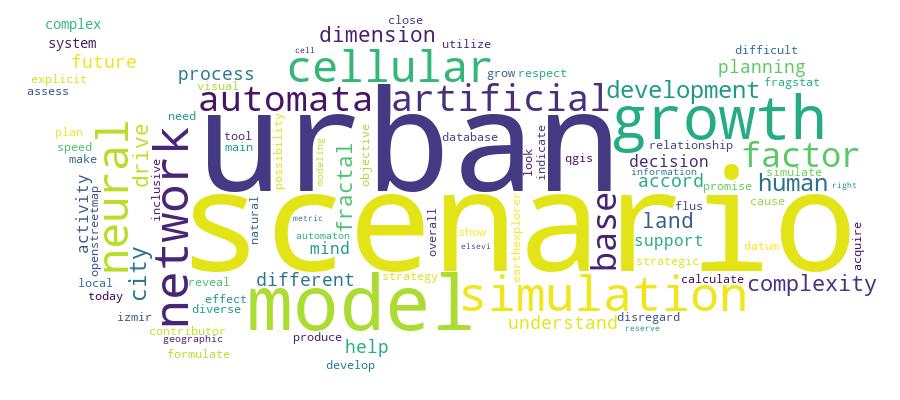
Competency Cloud

GCRIS Competency Cloud

Scholarly Output Search Results

Now showing 1 - 4 of 4
  • Article
    Scenario-Based Cellular Automata and Artificial Neural Networks in Urban Growth Modeling
    (2023) Gulen Cagdas; Nur Sipahioğlu
    The speed at which cities are growing and developing today cannot be disregarded. Human activities and natural causes are both contributors to urban growth. The relationship between these factors is complex and the complexity makes it difficult for the human mind alone to understand cities. A model that helps reveal the complexity is needed for urban studies. Main objective of this study is to understand the effects of urban planning strategies on the future of the city by utilizing a Cellular Automata and Artificial Neural Networks based simulation model. Driving factors of urban growth according to development scenarios were used in the simulation process. Six different development scenarios were formulated according to the strategic plan of Izmir. Land use and driving factor data used in simulating scenarios were acquired from EarthExplorer and OpenStreetMap databases and produced in QGIS. Future Land Use Simulation Model (FLUS) based on Cellular Automata (CA) and Artificial Neural Networks (ANN) was used. The results were assessed both by using FRAGSTATS which helped calculate fractal dimensions and visual analysis. Fractal dimension results of each scenario showed that the simulation model respected the overall urban complexity. A closer look at each scenario indicated the diverse local growth possibilities for different scenarios. The results show that urban simulation models when used as decision support tools promise a more inclusive and explicit planning process.
  • Article
    Citation - Scopus: 2
    Scenario-Based Cellular Automata and Artificial Neural Networks in Urban Growth Modeling
    (GAZI UNIV, 2023) Nur Sipahioglu; Gulen Cagdas; Cagdas, Gulen; Sipahioğlu, Nur
    The speed at which cities are growing and developing today cannot be disregarded. Human activities and natural causes are both contributors to urban growth. The relationship between these factors is complex and the complexity makes it difficult for the human mind alone to understand cities. A model that helps reveal the complexity is needed for urban studies. Main objective of this study is to understand the effects of urban planning strategies on the future of the city by utilizing a Cellular Automata and Artificial Neural Networks based simulation model. Driving factors of urban growth according to development scenarios were used in the simulation process. Six different development scenarios were formulated according to the strategic plan of Izmir. Land use and driving factor data used in simulating scenarios were acquired from EarthExplorer and OpenStreetMap databases and produced in QGIS. Future Land Use Simulation Model (FLUS) based on Cellular Automata (CA) and Artificial Neural Networks (ANN) was used. The results were assessed both by using FRAGSTATS which helped calculate fractal dimensions and visual analysis. Fractal dimension results of each scenario showed that the simulation model respected the overall urban complexity. A closer look at each scenario indicated the diverse local growth possibilities for different scenarios. The results show that urban simulation models when used as decision support tools promise a more inclusive and explicit planning process.
  • Article
    Scenario-Based Cellular Automata and Artificial Neural Networks in Urban Growth Modeling
    (Gazi Universitesi, 2023) Nur Sipahioglu; Gulen Cagdas
    The speed at which cities are growing and developing today cannot be disregarded. Human activities and natural causes are both contributors to urban growth. The relationship between these factors is complex and the complexity makes it difficult for the human mind alone to understand cities. A model that helps reveal the complexity is needed for urban studies. Main objective of this study is to understand the effects of urban planning strategies on the future of the city by utilizing a Cellular Automata and Artificial Neural Networks based simulation model. Driving factors of urban growth according to development scenarios were used in the simulation process. Six different development scenarios were formulated according to the strategic plan of Izmir. Land use and driving factor data used in simulating scenarios were acquired from EarthExplorer and OpenStreetMap databases and produced in QGIS. Future Land Use Simulation Model (FLUS) based on Cellular Automata (CA) and Artificial Neural Networks (ANN) was used. The results were assessed both by using FRAGSTATS which helped calculate fractal dimensions and visual analysis. Fractal dimension results of each scenario showed that the simulation model respected the overall urban complexity. A closer look at each scenario indicated the diverse local growth possibilities for different scenarios. The results show that urban simulation models when used as decision support tools promise a more inclusive and explicit planning process. © 2023 Elsevier B.V. All rights reserved.
  • Conference Object
    Computing Colour and Narrative in Architectural Sketches: A Model Framework to Support Sketching in Computational Design
    (The Association for Computer-Aided Architectural Design Research in Asia, 2025) Gurer, Ethem; Sipahioglu, Nur