Mortan Sevi, Oya

Loading...
Profile Picture
Name Variants
Oya Mortan Sevi
Job Title
Doç.Dr.
Email Address
Main Affiliation
01.01.05.03. Psikoloji Bölümü
Status
Current Staff
Website
Scopus Author ID
Turkish CoHE Profile ID
Google Scholar ID
WoS Researcher ID

Sustainable Development Goals

NO POVERTY1
NO POVERTY
0
Research Products
ZERO HUNGER2
ZERO HUNGER
0
Research Products
GOOD HEALTH AND WELL-BEING3
GOOD HEALTH AND WELL-BEING
0
Research Products
QUALITY EDUCATION4
QUALITY EDUCATION
0
Research Products
GENDER EQUALITY5
GENDER EQUALITY
0
Research Products
CLEAN WATER AND SANITATION6
CLEAN WATER AND SANITATION
0
Research Products
AFFORDABLE AND CLEAN ENERGY7
AFFORDABLE AND CLEAN ENERGY
0
Research Products
DECENT WORK AND ECONOMIC GROWTH8
DECENT WORK AND ECONOMIC GROWTH
0
Research Products
INDUSTRY, INNOVATION AND INFRASTRUCTURE9
INDUSTRY, INNOVATION AND INFRASTRUCTURE
0
Research Products
REDUCED INEQUALITIES10
REDUCED INEQUALITIES
0
Research Products
SUSTAINABLE CITIES AND COMMUNITIES11
SUSTAINABLE CITIES AND COMMUNITIES
0
Research Products
RESPONSIBLE CONSUMPTION AND PRODUCTION12
RESPONSIBLE CONSUMPTION AND PRODUCTION
0
Research Products
CLIMATE ACTION13
CLIMATE ACTION
0
Research Products
LIFE BELOW WATER14
LIFE BELOW WATER
0
Research Products
LIFE ON LAND15
LIFE ON LAND
0
Research Products
PEACE, JUSTICE AND STRONG INSTITUTIONS16
PEACE, JUSTICE AND STRONG INSTITUTIONS
2
Research Products
PARTNERSHIPS FOR THE GOALS17
PARTNERSHIPS FOR THE GOALS
0
Research Products
Documents

11

Citations

50

h-index

5

Documents

7

Citations

26

Scholarly Output

3

Articles

3

Views / Downloads

0/0

Supervised MSc Theses

0

Supervised PhD Theses

0

WoS Citation Count

0

Scopus Citation Count

5

Patents

0

Projects

0

WoS Citations per Publication

0.00

Scopus Citations per Publication

1.67

Open Access Source

0

Supervised Theses

0

JournalCount
Psychosis2
Anatolian Journal of Clinical Investigation1
Current Page: 1 / 1

Scopus Quartile Distribution

Quartile distribution chart data is not available

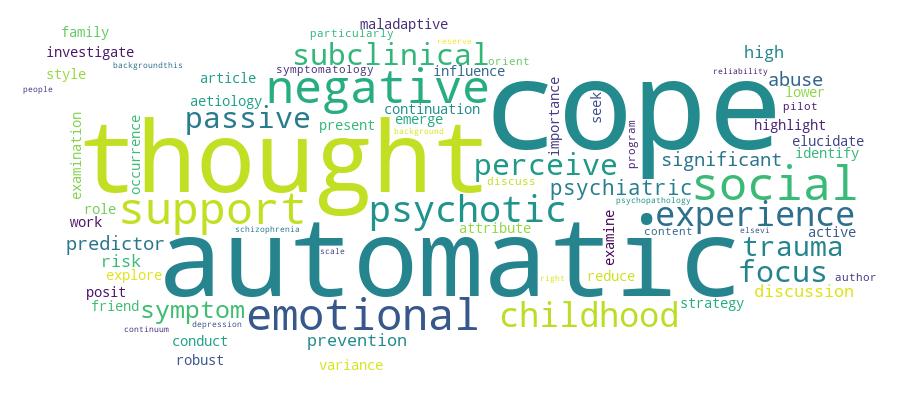
Competency Cloud

GCRIS Competency Cloud

Scholarly Output Search Results

Now showing 1 - 3 of 3
  • Article
    Exploring psychotic-like experiences: the role of negative automatic thoughts maladaptive coping social support and childhood trauma
    (ROUTLEDGE JOURNALS TAYLOR & FRANCIS LTD, 2025) Oya Mortan Sevi; Muge Gulen; Zekiye Zeybek; Nilufer Zulfikar; Mortan Sevi, Oya; Gulen, Muge; Zulfikar, Nilufer; Sevi, Oya Mortan; Zeybek, Zekiye
    BackgroundThis article presents the results of two studies investigating psychotic-like experiences conducted as a continuation of each other.MethodsStudy 1 (N = 472) sought to elucidate the aetiology of psychotic-like experiences (PLE) through an examination of automatic thoughts perceived social support and coping styles. Study 2 (N = 710) examined the influence of childhood trauma and coping strategies on the occurrence of subclinical psychiatric symptoms and PLE.ResultsStudy 1 posits that 52% of the variance in PLE can be attributed to more negative automatic thoughts lower active and higher passive-emotional focused coping and reduced social support from family friends and significant others. Negative automatic thoughts emerge as the most significant predictor. Study 2 identifies emotional abuse and passive-emotional focused coping as robust predictors of both PLE and subclinical psychiatric symptoms.DiscussionThe discussion highlights the importance of negative automatic thoughts perceived social support childhood emotional abuse and passive-emotional focused coping when working with subclinical symptomatology particularly PLE. The authors also discuss the content and results of a pilot coping-oriented prevention program for those at risk.
  • Article
    Exploring psychotic-like experiences: the role of negative automatic thoughts maladaptive coping social support and childhood trauma
    (Routledge, 2025) Oya Mortan Sevi; Müge Gülen; Zekiye Zeybek; Nilüfer Zülfikar
    Background: This article presents the results of two studies investigating psychotic-like experiences conducted as a continuation of each other. Methods: Study 1 (N = 472) sought to elucidate the aetiology of psychotic-like experiences (PLE) through an examination of automatic thoughts perceived social support and coping styles. Study 2 (N = 710) examined the influence of childhood trauma and coping strategies on the occurrence of subclinical psychiatric symptoms and PLE. Results: Study 1 posits that 52% of the variance in PLE can be attributed to more negative automatic thoughts lower active and higher passive-emotional focused coping and reduced social support from family friends and significant others. Negative automatic thoughts emerge as the most significant predictor. Study 2 identifies emotional abuse and passive-emotional focused coping as robust predictors of both PLE and subclinical psychiatric symptoms. Discussion: The discussion highlights the importance of negative automatic thoughts perceived social support childhood emotional abuse and passive-emotional focused coping when working with subclinical symptomatology particularly PLE. The authors also discuss the content and results of a pilot coping-oriented prevention program for those at risk. © 2025 Elsevier B.V. All rights reserved.