
Chatzikonstantinou, ioannis
Loading...

Name Variants
Ioannis Chatzikonstantinou
Job Title
Öğrt.Gör.
Email Address
Main Affiliation
01.01.10.02. Mimarlık Bölümü
Status
Former Staff
Website
ORCID ID
Scopus Author ID
Turkish CoHE Profile ID
Google Scholar ID
WoS Researcher ID
Sustainable Development Goals
 1
1NO POVERTY
0
Research Products
 2
2ZERO HUNGER
2
Research Products
 3
3GOOD HEALTH AND WELL-BEING
2
Research Products
 4
4QUALITY EDUCATION
0
Research Products
 5
5GENDER EQUALITY
0
Research Products
 6
6CLEAN WATER AND SANITATION
0
Research Products
 7
7AFFORDABLE AND CLEAN ENERGY
2
Research Products
 8
8DECENT WORK AND ECONOMIC GROWTH
0
Research Products
 9
9INDUSTRY, INNOVATION AND INFRASTRUCTURE
2
Research Products
 10
10REDUCED INEQUALITIES
0
Research Products
 11
11SUSTAINABLE CITIES AND COMMUNITIES
4
Research Products
 12
12RESPONSIBLE CONSUMPTION AND PRODUCTION
2
Research Products
 13
13CLIMATE ACTION
0
Research Products
 14
14LIFE BELOW WATER
3
Research Products
 15
15LIFE ON LAND
0
Research Products
 16
16PEACE, JUSTICE AND STRONG INSTITUTIONS
0
Research Products
 17
17PARTNERSHIPS FOR THE GOALS
1
Research Products

This researcher does not have a Scopus ID.

Documents
22
Citations
421

Scholarly Output
36
Articles
7
Views / Downloads
0/0
Supervised MSc Theses
0
Supervised PhD Theses
0
WoS Citation Count
397
Scopus Citation Count
514
Patents
0
Projects
0
WoS Citations per Publication
11.03
Scopus Citations per Publication
14.28
Open Access Source
2
Supervised Theses
0
| Journal | Count |
|---|---|
| IEEE Congress on Evolutionary Computation (CEC) | 6 |
| IEEE Congress on Evolutionary Computation (CEC) held as part of IEEE World Congress on Computational Intelligence (IEEE WCCI) | 5 |
| IEEE Congress on Evolutionary Computation CEC 2015 | 5 |
| 2016 IEEE Congress on Evolutionary Computation CEC 2016 | 5 |
| Architectural Science Review | 2 |
Current Page: 1 / 3
Scopus Quartile Distribution
Quartile distribution chart data is not available
Competency Cloud
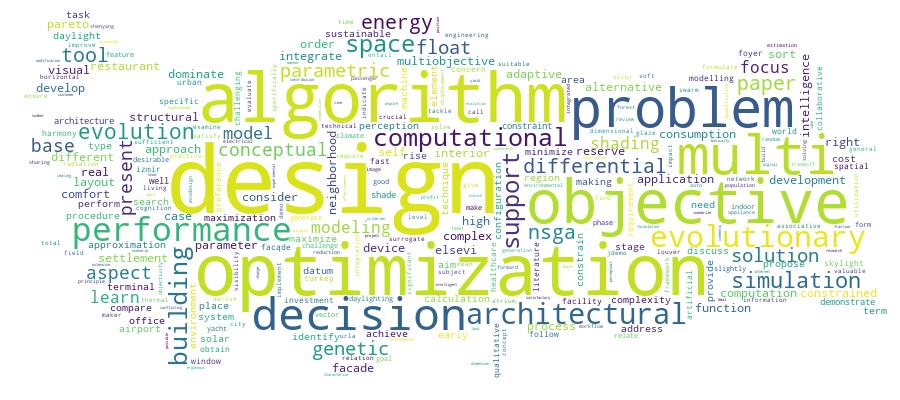
36 results
Scholarly Output Search Results
Now showing 1 - 10 of 36
Conference Object pCOLAD: online sharing of parameters for collaborative architectural design(ECAADE-EDUCATION & RESEARCH COMPUTER AIDED ARCHITECTURAL DESIGN EUROPE, 2014) Hans J. C. Hubers; Michela Turrin; Irem Erbas; Ioannis Chatzikonstantinou; EM ThompsonSimultaneous interdisciplinary architectural design from the very start of a project faces challenges in properly sharing information across disciplines. This research developed a method and related digital tool to improve collaborative design and aimed at making selected information to be shared faster and more transparently. The method consists of developing alternative parametric solutions for different parts of the design in such a way that crucial parameters form a link between these parts. The digital tool has been developed for Grasshopper and permits synchronic (real-time over the Internet) and a-synchronic sharing of these parameters. The design alternatives are evaluated with specific criteria pros and cons in an Internet Forum and discussed via a video-conferencing tool. Decisions are then taken in a collaborative manner through voting. The paper describes the method based on a case study.Conference Object A Multi-Objective Self-Adaptive Differential Evolution Algorithm for Conceptual High-Rise Building Design(IEEE, 2016) Berk Ekici; Ioannis Chatzikonstantinou; Sevil Sariyildiz; M. Fatih Tasgetiren; Quan-Ke PanThis paper presents a multi-objective self-adaptive differential evolution algorithm to solve the form-finding problem of high-rise building design in the conceptual phase. The aim of the research is to reach suitable high-rise design alternatives for hard and soft objectives which are construction cost per square meter structural displacement and visual perception of the spaces from the inside out subject to several constraints that are related with both high-rise construction regulations and profitability of the spaces. We formulate the problem as a multi-objective real-parameter constrained optimization problem for three objectives that are inherently conflicting. To tackle this problem we developed two different optimization algorithms namely a Non-Dominated Sorting Genetic Algorithm II (NSGA-II) and a Self-Adaptive Differential Evolution Algorithm (jDE) in order to obtain Pareto fronts with diversified non-dominated solutions. The extensive computational results show that the jDE algorithm yields much more desirable Pareto front than the NSGA-II algorithm.Conference Object Citation - WoS: 6Citation - Scopus: 7Conceptual Airport Terminal Design using Evolutionary Computation(IEEE, 2015) Ioannis Chatzikonstantinou; Sevil Sariyildiz; Michael S. Bittermann; Sariyildiz, Sevil; Chatzikonstantinou, Ioannis; Bittermann, Michael S.Passenger terminals are very complex buildings not only in their function form and structure but also in infrastructure security comfort energy which deal with huge investments both in terms of capital as well as in terms of resources and environmental impact. As such it is expected that they are designed to fulfill their purpose while minimizing their negative aspects to the environment. Identifying design solutions that satisfy these goals is a challenging task due to the complexity involved. The design task is characterized by excessive number of solutions conflicting goals and complex relations between design decision variables objectives and constraints. As such appropriate informed decisions that integrate as many design aspects as possible should be ensured as early as the conceptual stage of the design. In this study the problem of conceptual airport terminal design is addressed by means of computational decision support methodologies. The proposed method is based on the integration of the following components: i. a parametric modeling approach for enabling the instantaneous generation of a wide variety of designs ii. a multi-faceted evaluation scheme which integrates functional energy and architectural aspects iii. a Multi-Objective Genetic Algorithm namely the NSGA-II to identify well performing solutions. A computational model implementing the method is outlined and validation of the method is performed based on two different scenarios corresponding to commonly occurring airport configurations. The performance of two optimization runs with different population sizes as well as qualitative aspects of the resulting solutions is discussed.Conference Object Designing self-sufficient floating neighborhoods using computational decision support(Institute of Electrical and Electronics Engineers Inc., 2015) Ayca Kirimtat; Ioannis Chatzikonstantinou; I. Sevil Sariyildiz; Ayca TartarFloating settlements which introduce further design complexities over traditional developments have become an alternative for urban development due to climate change and shortage of land. This study aims to develop a floating settlement concept that presents an approach to the design of floating neighborhoods using parametric modelling techniques in combination with Intelligent Decision Support tools and optimization methods. Optimization results of two algorithms namely NSGA-II and DE are compared regarding to objectives. The objectives considered in this study are walkability within the neighborhoods scenic view and cost-effectiveness. Results suggest that DE performs better than NSGA-II in this problem. An application of the method is presented focusing on the design of floating neighborhoods in the project area namely Urla which is a seaside place along the coastline of Izmir Turkey. © 2017 Elsevier B.V. All rights reserved.Article Citation - WoS: 30Citation - Scopus: 42Approximation of simulation-derived visual comfort indicators in office spaces: a comparative study in machine learning(TAYLOR & FRANCIS LTD, 2016) Ioannis Chatzikonstantinou; Sevil Sariyildiz; Sariyildiz, Sevil; Chatzikonstantinou, IoannisIn performance-oriented architectural design the use of advanced computational simulation tools may provide valuable insight during design. However the use of such tools is often a bottleneck in the design process given that computational requirements are usually high. This is a fact that mostly affects the early conceptual stage of design where crucial decisions mainly occur and available time is limited. In order to deal with this decision-makers frequently resort to drawing conclusions from experience and as such valuable insight that advanced computational methods have to offer is lost. This paper explores an alternative approach which builds on machine-learning algorithms that inductively learn from simulation-derived data yielding models that approximate to a good degree and are orders of magnitude faster. We focus on visual comfort of office spaces. This is a type of space that specifically requires visual comfort more than others. Three machine-learning methods are compared with respect to applicability in approximating daylight autonomy and daylight glare probability. The comparison focuses on accuracy and time cost of training and estimation. Results demonstrate that machine-learning-based approaches achieve a favourable trade-off between accuracy and computational cost and provide a worthwhile alternative for performance evaluations during architectural conceptual design.Article Approximation of simulation-derived visual comfort indicators in office spaces: A comparative study in machine learning(Taylor and Francis Ltd. michael.wagreich@univie.ac.at, 2016) Ioannis Chatzikonstantinou; I. Sevil SariyildizIn performance-oriented architectural design the use of advanced computational simulation tools may provide valuable insight during design. However the use of such tools is often a bottleneck in the design process given that computational requirements are usually high. This is a fact that mostly affects the early conceptual stage of design where crucial decisions mainly occur and available time is limited. In order to deal with this decision-makers frequently resort to drawing conclusions from experience and as such valuable insight that advanced computational methods have to offer is lost. This paper explores an alternative approach which builds on machine-learning algorithms that inductively learn from simulation-derived data yielding models that approximate to a good degree and are orders of magnitude faster. We focus on visual comfort of office spaces. This is a type of space that specifically requires visual comfort more than others. Three machine-learning methods are compared with respect to applicability in approximating daylight autonomy and daylight glare probability. The comparison focuses on accuracy and time cost of training and estimation. Results demonstrate that machine-learning-based approaches achieve a favourable trade-off between accuracy and computational cost and provide a worthwhile alternative for performance evaluations during architectural conceptual design. © 2016 Elsevier B.V. All rights reserved.Conference Object pCOLAD: online sharing of parameters for collaborative architectural design(Education and research in Computer Aided Architectural Design in Europe, 2014) Hans J.C. Hubers; Michela Turrin; Irem Erbas; Ioannis Chatzikonstantinou; Turrin, Michela; Erbas, Irem; Chatzikonstantinou, Ioannis; Hubers, Hans J. C.; E.M. ThompsonSimultaneous interdisciplinary architectural design from the very start of a project faces challenges in properly sharing information across disciplines. This research developed a method and related digital tool to improve collaborative design and aimed at making selected information to be shared faster and more transparently. The method consists of developing alternative parametric solutions for different parts of the design in such a way that crucial parameters form a link between these parts. The digital tool has been developed for Grasshopper and permits synchronic (real-time over the Internet) and a-synchronic sharing of these parameters. The design alternatives are evaluated with specific criteria pros and cons in an Internet Forum and discussed via a video-conferencing tool. Decisions are then taken in a collaborative manner through voting. The paper describes the method based on a case study. © 2024 Elsevier B.V. All rights reserved.Conference Object Citation - WoS: 3Citation - Scopus: 3Interior Spatial Layout with Soft Objectives using Evolutionary Computation(IEEE, 2016) Ioannis Chatzikonstantinou; Ebru Bengisu; Chatzikonstantinou, Ioannis; Bengisu, EbruThis paper presents the design problem of furniture arrangement in a residential interior living space and addresses it by means of evolutionary computation. Interior arrangement is an important and interesting problem that occurs commonly when designing living spaces. It entails determining the locations of interior elements such as tables seating elements projection screens etc. in order to satisfy objectives. Despite it's commonality it is a challenging problem that entails mainly soft objectives related to perception and ergonomics as well as challenging constraints. This paper is an attempt to address this problem by means of Evolutionary Computation. We discuss the problem formulation focusing on perceptual aspects of the various elements of space. In particular we formulate a three objective problem with the following objectives: Maximization of visual perception of openings to the outside maximization of inter-person visual perception from the seating places and maximization of the openness of space. We provide results from a comparison of two MOEAs namely NSGA-II and HypE.Conference Object Engineering Performance Simulations in Architectural Design Conception Atrium in Shenyang: a case study on thermal mass(Education and research in Computer Aided Architectural Design in Europe, 2013) Michela Turrin; Ioannis Chatzikonstantinou; Martin J. Tenpierik; I. Sevil Sariyildiz; Turrin, Michela; Sariyildiz, Sevil; Chatzikonstantinou, Ioannis; Tenpierik, Martin; R. Stouffs , S. SariyildizThe paper tackles the integration of engineering performance simulations in the conceptual phase of architectural design with specific focus on parametric design processes. A general framework is exemplified in which the use of performance simulations and the learning process of the designer are discussed in relation to the parameterization process. A specific case study is presented more in details regarding the design of an atrium for the reuse of an existing building in Shenyang-China. Performance simulations concerning the thermal comfort in the atrium are presented and discussed in relation to the general framework. © 2022 Elsevier B.V. All rights reserved.Conference Object Citation - WoS: 9Citation - Scopus: 10Multi-Objective skylight optimization for a healthcare facility foyer space(Institute of Electrical and Electronics Engineers Inc., 2017) Muhittin Yufka; Berk Ekici; Cemre Cubukcuoglu; Ioannis Chatzikonstantinou; I. Sevil Sariyildiz; Ekici, Berk; Chatzikonstantinou, Ioannis; Sariyildiz, I. Sevil; Yufka, Muhittin; Cubukcuoglu, CemreIn this paper the design of a specific case study of a foyer space is concerned in healthcare facility. The design task of a healthcare facility in architectural perspective is one of the most challenging tasks in the architectural design field since it involves different spaces that have unique requirements. Specifically a foyer space has been considered as a gathering area that answers people's needs and expectations. The study shows an application of computational intelligence for a skylight design in foyer space. For this reason objective functions are considered to minimize skylight cost and to maximize the daylight performance of the interior space. Multi-Objective Self-Adaptive Ensemble Differential Evolution Algorithm and Non-Dominated Sorting Genetic Algorithm-II are proposed to tackle this complex problem. According to results jE-DEMO algorithm presents satisfactory solutions as well as NSGA-II. © 2017 Elsevier B.V. All rights reserved.
