
Kilinç, Kivanç
Loading...

Name Variants
Kivanç Kilinç
Job Title
Dr.Öğr.Üyesi
Email Address
Main Affiliation
01.01.10.02. Mimarlık Bölümü
Status
Former Staff
Website
ORCID ID
Scopus Author ID
Turkish CoHE Profile ID
Google Scholar ID
WoS Researcher ID
Sustainable Development Goals
 1
1NO POVERTY
0
Research Products
 2
2ZERO HUNGER
0
Research Products
 3
3GOOD HEALTH AND WELL-BEING
0
Research Products
 4
4QUALITY EDUCATION
0
Research Products
 5
5GENDER EQUALITY
0
Research Products
 6
6CLEAN WATER AND SANITATION
0
Research Products
 7
7AFFORDABLE AND CLEAN ENERGY
0
Research Products
 8
8DECENT WORK AND ECONOMIC GROWTH
0
Research Products
 9
9INDUSTRY, INNOVATION AND INFRASTRUCTURE
0
Research Products
 10
10REDUCED INEQUALITIES
1
Research Products
 11
11SUSTAINABLE CITIES AND COMMUNITIES
3
Research Products
 12
12RESPONSIBLE CONSUMPTION AND PRODUCTION
0
Research Products
 13
13CLIMATE ACTION
0
Research Products
 14
14LIFE BELOW WATER
0
Research Products
 15
15LIFE ON LAND
0
Research Products
 16
16PEACE, JUSTICE AND STRONG INSTITUTIONS
0
Research Products
 17
17PARTNERSHIPS FOR THE GOALS
0
Research Products

This researcher does not have a Scopus ID.

Documents
12
Citations
22

Scholarly Output
7
Articles
5
Views / Downloads
0/0
Supervised MSc Theses
0
Supervised PhD Theses
0
WoS Citation Count
10
Scopus Citation Count
10
Patents
0
Projects
0
WoS Citations per Publication
1.43
Scopus Citations per Publication
1.43
Open Access Source
1
Supervised Theses
0
| Journal | Count |
|---|---|
| History and Memory | 2 |
| Architectural Histories | 1 |
| Contemporary Urban Landscapes of the Middle East | 1 |
| Digital Scholarship in the Humanities | 1 |
| Farewell to Visual Studies | 1 |
Current Page: 1 / 2
Scopus Quartile Distribution
Quartile distribution chart data is not available
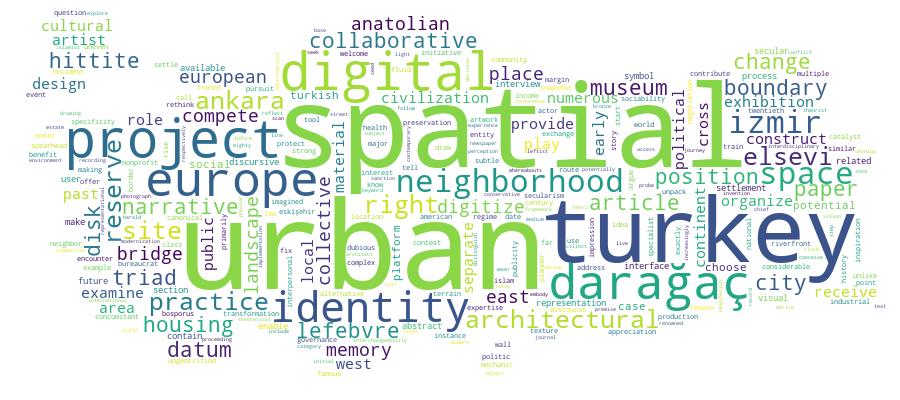
Competency Cloud
7 results
Scholarly Output Search Results
Now showing 1 - 7 of 7
Article Citation - WoS: 6Citation - Scopus: 6Digitizing Lefebvre's Spatial Triad(Oxford University Press, 2018) Gülsüm Baydar; Murat Komesli; Ahenk Yılmaz; Kivanç Kilinç; Kilinc, Kivanc; Yilmaz, Ahenk; Baydar, Gulsum; Komesli, MuratDigitizing Lefebvre's Spatial Triad is conceived as a seed project for an interdisciplinary analysis of the built environment via digital media. Two social housing projects in _Izmir are chosen as case studies as an initial step to be developed toward a potentially international digital platform. The theoretical premises of the project are based on the renowned cultural theorist Henri Lefebvre's Spatial Triad which distinguishes between representations of space representational spaces or spaces of representation and spatial practices. Following this framework the collected data are organized in three sections which are reflected in the digital interface. These are respectively titled 'implementations' which contains architectural drawings and visual recordings of interviews with the chief architect of the projects, 'perceptions' which includes related texts that are scanned from Web sites newspapers journals and conference proceedings, and 'lived experiences' which contains photographs and visual records of on-site interviews with the users of the two housing estates. Users of the digital interface are enabled access to data in each category by means of choosing one of eighty-three related keywords. The latter are derived from the digital analyses of discursive material. By enabling the comparison of the sections of spatial data for each settlement and between the two settlements the digital platform has the potential to inform decision-making processes in future social housing projects. © 2018 Elsevier B.V. All rights reserved.Review The hittite sun is rising once again : Contested narratives of identity place and memory in Ankara(Indiana University Press journals@indiana.edu, 2017) Kivanç KilinçThis article seeks to shed light on the journey of the Hittite sun disk a cult object from the Early Bronze Age from the architectural narrative and discursive boundaries of a public museum to the streets of contemporary Ankara. First it explores the role that the Museum of Anatolian Civilizations played through the invention of secular symbols in (re)defining modern Turkish identity. Then it probes into the processes by which the sun disk became an increasingly popular and yet controversial political symbol. In doing so the article examines how a state-sanctioned memory-making project heralded a "clash of imaginations": conservative and Islamist versus secular-leftist urban identities embodying conflicting visions of Ankara's past and future. © 2017 Elsevier B.V. All rights reserved.Article Citation - WoS: 2Citation - Scopus: 3The Hittite Sun Is Rising Once Again Contested Narratives of Identity Place and Memory in Ankara(INDIANA UNIV PRESS, 2017) Kivanc Kilinc; Kilinç, KivançThis article seeks to shed light on the journey of the Hittite sun disk a cult object from the Early Bronze Age from the architectural narrative and discursive boundaries of a public museum to the streets of contemporary Ankara. First it explores the role that the Museum of Anatolian Civilizations played through the invention of secular symbols in (re) defining modern Turkish identity. Then it probes into the processes by which the sun disk became an increasingly popular and yet controversial political symbol. In doing so the article examines how a state-sanctioned memory-making project heralded a clash of imaginations: conservative and Islamist versus secular-leftist urban identities embodying conflicting visions of Ankara's past and future.Article Becoming One with the Neighborhood: Collaborative Art Space-Making and Urban Change in Izmir Darağaç(SAGE Publications Inc., 2024) Kivanç Kilinç; Burkay Pasin; Guzden VarinliogluDarağaç is a former industrial lower-income neighborhood in Turkey’s third-largest city Izmir. In 2015 several artists settled in the area and started a nonprofit initiative called the Darağaç Collective (DC). DC has since organized numerous art events and exhibitions receiving considerable interest and publicity. Yet to date the changes in Darağaç’s material landscapes have been subtle and the area remains ungentrified unlike similar examples in Turkey. This article argues that the collaborative art practice spearheaded by DC played a major role in the preservation of the neighborhood’s urban texture. The artists became neighbors with the residents benefited from the expertise of mechanics and drew inspiration from the site while the local community has contributed to the production exhibition and appreciation of artworks. Thus art has become a tool for sociability and a catalyst for interpersonal cultural and cross-class exchanges which could offer an alternative route to art-led urban change in Turkey. © 2024 Elsevier B.V. All rights reserved.Book Part Should we have known our place after all?(Penn State University Press, 2015) Kivanç Kilinç; Kilinç, Kivanç[No abstract available]Article 'Welcome to Europe': A bridge east of architectural history(Web Portal Ubiquity Press, 2018) Kivanç Kilinç; Kilinç, KivançThis position paper examines the complex boundaries that separate Europe from both its constructed margins and those of its imagined Others. Where exactly do we enter the Continent and where does it end? Is it while crossing the world-famous bridge on the Bosporus for instance that one receives the first impression of Europe or is it somewhere farther west - past a 'wall' protected by a strong border regime? To address these questions this paper tells two concomitant stories about the practices of urban governance and architectural design in Turkey in the early twentieth century by providing snapshots of numerous encounters and negotiations between multiple actors: American public health specialists European-trained local bureaucrats and a French city planner. While Turkey's dubious position between the West and the East provides the potential for rethinking the boundaries of the Continent the paper uses the Turkish case primarily to unpack the idea of 'Europe' as both a fluid entity and a fixed location an uneven terrain upon which canonical discourses of identity are constructed. In doing so it points to the interchangeability of subject positions which often result in competing narratives of modernization urban design and the whereabouts of the line separating Turkey from Europe. © 2022 Elsevier B.V. All rights reserved.Book Part Citation - WoS: 2Citation - Scopus: 1In pursuit of a European city: Competing landscapes of Eskişehir's riverfront(Taylor and Francis Inc., 2016) Kivanç Kilinç; Duygu Kaçar; Kilinç, Kivanç; Kaçar, Duygu[No abstract available]
