
Candan Şimşek, Ayşe
Loading...

Name Variants
Ayşe Candan Şimşek
Job Title
Dr.Öğr.Üyesi
Email Address
Main Affiliation
01.01.05.03. Psikoloji Bölümü
Status
Former Staff
Website
ORCID ID
Scopus Author ID
Turkish CoHE Profile ID
Google Scholar ID
WoS Researcher ID
Sustainable Development Goals
SDG data is not available

This researcher does not have a Scopus ID.

Documents
16
Citations
322

Scholarly Output
5
Articles
5
Views / Downloads
0/1
Supervised MSc Theses
0
Supervised PhD Theses
0
WoS Citation Count
3
Scopus Citation Count
1
Patents
0
Projects
0
WoS Citations per Publication
0.60
Scopus Citations per Publication
0.20
Open Access Source
1
Supervised Theses
0
| Journal | Count |
|---|---|
| Visual Cognition | 2 |
| Current Psychology | 1 |
| European Journal of Geriatrics and Gerontology | 1 |
| Psychology of Aesthetics, Creativity, and the Arts | 1 |
Current Page: 1 / 1
Scopus Quartile Distribution
Quartile distribution chart data is not available
Competency Cloud
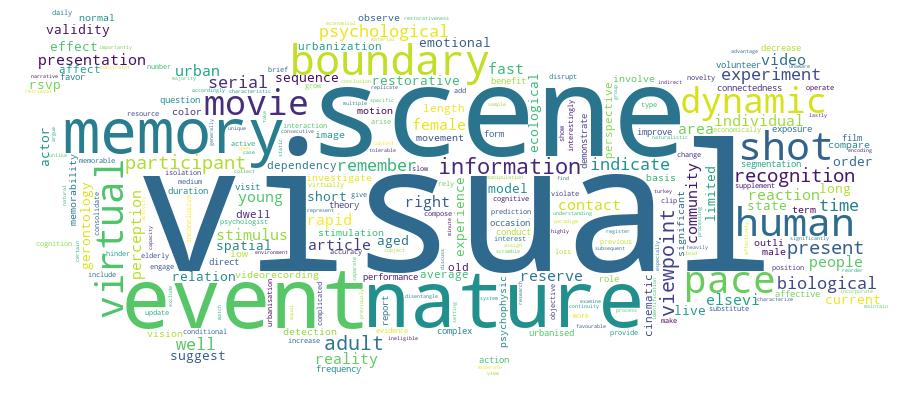
5 results
Scholarly Output Search Results
Now showing 1 - 5 of 5
Article Remembering Cinematic Sequences: Boundaries Disrupt Memory in Fast-Paced Visual Events(American Psychological Association, 2024) Ayşe Candan Şimşek; Elif Kurum; Şimşek, Ayşe Candan; Kurum, ElifWe engage with at least one type of visual media on a daily basis. Among those there is a growing interest in the perception of cinematic events among cognitive psychologists. The current study investigated how event boundaries and pace affect recognition memory for movie scenes. We presented participants with brief clips composed out of six shots which either included a boundary or not and whether the average shot length was long or short. The results indicated that slower paced scenes were remembered better than faster paced scenes. More interestingly there was a significant interaction between event boundary and pace. For fast-paced scenes lower accuracy as well as longer reaction times were observed for scenes that involved an event boundary compared to those without an event boundary. Analysis of the serial position of the individual shots further indicated that people remember information in the new scene compared to the old scene only for fast-paced scenes. Event segmentation theory states that we form an active model of an event in working memory which is updated when there is a significant change that violates predictions. Our experiment adds to event segmentation theory suggesting that the role of event boundaries is conditional on the exposure duration. When information is consolidated with enough exposure the experience of an event boundary does not hinder memory. The current study provides new evidence showing that in complex visual scenes memory operates economically to rely on the current model when the resources are limited. © 2024 Elsevier B.V. All rights reserved.Article Citation - WoS: 3Citation - Scopus: 1What makes a visual scene more memorable? A rapid serial visual presentation (RSVP) study with dynamic visual scenes(ROUTLEDGE JOURNALS TAYLOR & FRANCIS LTD, 2023) Ayse Candan Simsek; Nazif Karaca; Berk Can Kirmizi; Furkan Ekiz; Karaca, Nazif; Simsek, Ayse Candan; Kirmizi, Berk Can; Ekiz, Furkan; Candan Şimşek, AyşeThe visual system has been characterized as having limited processing capacity. Research suggests that not all visual information is equal and that certain visual scenes are registered better than others. The present study investigated how people process biological stimuli under time constraint using a Rapid Serial Visual Presentation (RSVP) paradigm with dynamic movie scenes. The results of Experiments 1 and 2 indicated that recognition memory as well as identification performance got better with longer duration (400 ms vs. 200 ms). Most importantly biological stimuli led to better memory and lower reaction times. Lastly Experiment 3 was conducted to replicate previously observed dynamic advantage and to disentangle the role of motion from content. The results indicated that dynamic scenes were remembered better than static scenes for both the biological and non-biological stimuli. The ecological validity and retrieval benefit of dynamic scenes were discussed in relation to image memorability.Article Restorative Effects of Virtual Nature on the Emotional Well-being of Community-dwelling Older Adults(Galenos Publishing House, 2024) Kenan Eren Şansal; Ayşe Candan Şimşek; Selin Aktan; Fulya Özbey; Ayça PaksoyObjective: Given the loss of direct nature contact due to urbanisation and demonstrated psychological benefits of nature the question arises as to whether direct nature contact can be virtually substituted or supplemented in the elderly living in isolation from nature. Although a number of studies have demonstrated the restorative effects of virtual nature in old age their results are inconclusive and complicated by the novelty of virtual reality (VR) experience participants’ nature connectedness and their previous nature contact. Therefore a study was conducted for increasing our limited understanding of the subject. Materials and Methods: Community-dwelling older adults living in highly urbanised areas of Turkey volunteered for the study. After excluding the ineligible volunteers and collecting information on sample characteristics 60 participants who were assigned to two study groups watched 6-minute 360° videos of nature and urban settings on two separate occasions. On these occasions they reported on their affective states the restorativeness of the environments in those videos and their nature visit frequency. Results: VR experience was new and tolerable for the majority of the participants. Unlike the urban video the nature video significantly improved participants’ affective states and was reported to be more restorative and favourable. Neither participants’ nature connectedness nor their nature visit frequency which was found to be generally low did not have a moderating effect on the results. Conclusion: Virtual indirect contact with nature can be effectively used especially for those living in heavily urbanised areas to maintain or improve psychological well-being in old age. © 2024 Elsevier B.V. All rights reserved.Article What makes a visual scene more memorable? A rapid serial visual presentation (RSVP) study with dynamic visual scenes(Routledge, 2023) Ayşe Candan Şimşek; Nazif Karaca; Berk Can Kırmızı; Furkan EkizThe visual system has been characterized as having limited processing capacity. Research suggests that not all visual information is equal and that certain visual scenes are registered better than others. The present study investigated how people process biological stimuli under time constraint using a Rapid Serial Visual Presentation (RSVP) paradigm with dynamic movie scenes. The results of Experiments 1 and 2 indicated that recognition memory as well as identification performance got better with longer duration (400 ms vs. 200 ms). Most importantly biological stimuli led to better memory and lower reaction times. Lastly Experiment 3 was conducted to replicate previously observed dynamic advantage and to disentangle the role of motion from content. The results indicated that dynamic scenes were remembered better than static scenes for both the biological and non-biological stimuli. The ecological validity and retrieval benefit of dynamic scenes were discussed in relation to image memorability. © 2024 Elsevier B.V. All rights reserved.Article One perspective or two? Viewpoint dependency in visual events(Springer, 2024) Ayşe Candan Şimşek; Tolgahan Aydın; Zeynep Gunes OzkanViewpoint dependency in dynamic events is still an open question. Movies present a unique case of complex visual stimuli where consecutive shots are filmed from multiple viewpoints. In the present study we have examined whether people remember viewpoint-specific information in movie-like visual scenes. We have used naturalistic activities which involved two actors where a) the sequence is presented from one or both actors’ viewpoints and b) the individual actions were in a natural order or they were scrambled. The results indicated that memory for individual shots decreased when the sequence was presented from both actors’ perspectives. Also people were mostly unaware of the order manipulation and reordering the individual actions did not lead to a decrease in memory performance. The results favor the film-form model which suggests that the spatial relations in movie scenes are represented by taking the first shot of a scene as the basis and incorporating the views in subsequent shots accordingly. This argues for an economical encoding in visual events which favors narrative continuity over spatial relations. © 2024 Elsevier B.V. All rights reserved.
