
Erdoğdu Erkarslan, Özlem
Loading...

Name Variants
Özlem Erdoǧdu Erkarslan
Ozlem-Erdogdu Erkarslan
Ozlem Erdogdu Erkarslan
Ozlem-Erdogdu Erkarslan
Ozlem Erdogdu Erkarslan
Job Title
Prof.Dr.
Email Address
Main Affiliation
01.01.10.02. Mimarlık Bölümü
Status
Former Staff
Website
ORCID ID
Scopus Author ID
Turkish CoHE Profile ID
Google Scholar ID
WoS Researcher ID
Sustainable Development Goals
 1
1NO POVERTY
0
Research Products
 2
2ZERO HUNGER
0
Research Products
 3
3GOOD HEALTH AND WELL-BEING
0
Research Products
 4
4QUALITY EDUCATION
4
Research Products
 5
5GENDER EQUALITY
0
Research Products
 6
6CLEAN WATER AND SANITATION
0
Research Products
 7
7AFFORDABLE AND CLEAN ENERGY
0
Research Products
 8
8DECENT WORK AND ECONOMIC GROWTH
0
Research Products
 9
9INDUSTRY, INNOVATION AND INFRASTRUCTURE
0
Research Products
 10
10REDUCED INEQUALITIES
0
Research Products
 11
11SUSTAINABLE CITIES AND COMMUNITIES
0
Research Products
 12
12RESPONSIBLE CONSUMPTION AND PRODUCTION
0
Research Products
 13
13CLIMATE ACTION
0
Research Products
 14
14LIFE BELOW WATER
2
Research Products
 15
15LIFE ON LAND
0
Research Products
 16
16PEACE, JUSTICE AND STRONG INSTITUTIONS
0
Research Products
 17
17PARTNERSHIPS FOR THE GOALS
2
Research Products

This researcher does not have a Scopus ID.

This researcher does not have a WoS ID.

Scholarly Output
8
Articles
8
Views / Downloads
0/0
Supervised MSc Theses
0
Supervised PhD Theses
0
WoS Citation Count
15
Scopus Citation Count
16
Patents
0
Projects
0
WoS Citations per Publication
1.88
Scopus Citations per Publication
2.00
Open Access Source
2
Supervised Theses
0
| Journal | Count |
|---|---|
| Archnet-IJAR: International Journal of Architectural Research | 2 |
| FAMagazine. Ricerche e progetti sull'architettura e la città | 2 |
| Frontiers in Built Environment | 2 |
| International Journal of Art & Design Education | 2 |
Current Page: 1 / 1
Scopus Quartile Distribution
Quartile distribution chart data is not available
Competency Cloud
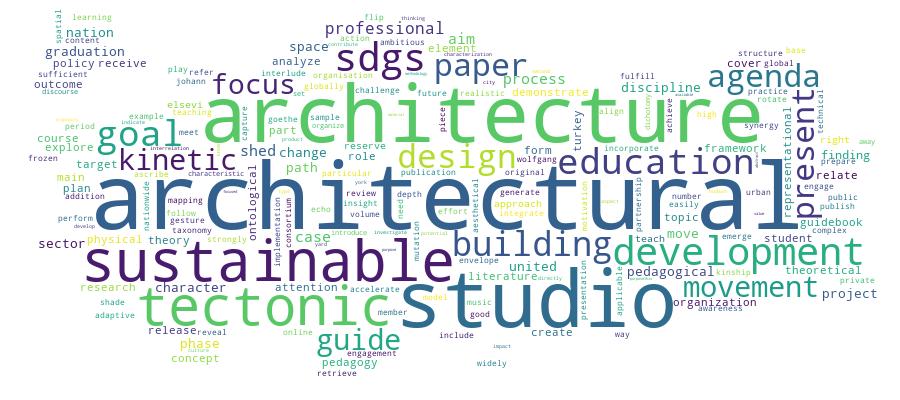
8 results
Scholarly Output Search Results
Now showing 1 - 8 of 8
Article Citation - WoS: 4Citation - Scopus: 5Incorporating United Nations 2030 Sustainable Future Agenda into the Architectural Studio: A Graduation Studio Case(John Wiley and Sons Inc, 2022) Özlem Erdoǧdu Erkarslan; Yenal Akgün; Erkarslan, Özlem Erdoğdu; Akgün, YenalUnited Nations (UN) released the 2030 Agenda for Sustainable Development in 2015. This agenda has received attention from various disciplines and sectors globally, partnerships from private and public sectors were formed to play a role in this challenging ambitious plan. However architectural education and professional organisations in Turkey have not been strongly engaged with the agenda in particular. To meet this gap and create synergy this paper aims at presenting pedagogical paths followed in a graduation studio integrating the studio outcomes with UN 2030 Sustainable Development Goals (SDGs) which have not been widely covered either in nationwide architectural education or professional policies. In addition the paper focuses on how the SDG action plan is echoed in higher education as well as in the discipline of architecture in Turkey. The paper is a case study in architectural education of which the motivation is to create awareness about UN SDGs among the students, to give insights and demonstrate a realistic design policy to achieve development targets. The pedagogical path presented here is original and aims to fulfill an interlude in the literature which is still emerging. The case presentation includes the process and the results with a sufficient number of student projects as outcomes of the studio. © 2022 Elsevier B.V. All rights reserved.Article Design and implementation of online learning process for complex architectural projects: a graduation project example during Covid-19 period(Festival Architettura Edizioni, 2021) Özlem Erdoǧdu Erkarslan; Yenal Akgün; Erkarslan, Ozlem Erdogdu; Akgun, Yenal[No abstract available]Article Incorporating United Nations 2030 Sustainable Future Agenda into the Architectural Studio: A Graduation Studio Case(WILEY, 2022) Ozlem Erdogdu Erkarslan; Yenal AkgunUnited Nations (UN) released the 2030 Agenda for Sustainable Development in 2015. This agenda has received attention from various disciplines and sectors globally, partnerships from private and public sectors were formed to play a role in this challenging ambitious plan. However architectural education and professional organisations in Turkey have not been strongly engaged with the agenda in particular. To meet this gap and create synergy this paper aims at presenting pedagogical paths followed in a graduation studio integrating the studio outcomes with UN 2030 Sustainable Development Goals (SDGs) which have not been widely covered either in nationwide architectural education or professional policies. In addition the paper focuses on how the SDG action plan is echoed in higher education as well as in the discipline of architecture in Turkey. The paper is a case study in architectural education of which the motivation is to create awareness about UN SDGs among the students, to give insights and demonstrate a realistic design policy to achieve development targets. The pedagogical path presented here is original and aims to fulfill an interlude in the literature which is still emerging. The case presentation includes the process and the results with a sufficient number of student projects as outcomes of the studio.Article Design and implementation of online learning process for complex architectural projects: a graduation project example during Covid-19 period(FESTIVAL ARCHITETTURA EDIZIONI, 2021) Ozlem Erdogdu Erkarslan; Yenal AkgunArticle Tectonics of kinetic architecture: Moving envelope changing space and the shades of the shed(Frontiers Media S.A., 2022) Yenal Akgün; Özlem Erdoǧdu Erkarslan; Canberk KavuncuoğluBuildings in our day are no more frozen pieces of music as ascribed by Johann Wolfgang von Goethe. They can move rotate flip and perform various physical gestures. This paper aims to explore the spatial aesthetical and technical characteristics of kinetic buildings within the framework of the theory of tectonics which is still far away from covering the art form of movement. The study has been organized into two phases. The first phase sets up the theoretical framework of the topic by exploring the main dichotomy of the tectonic discourse on “ontological and representational parts of the building” and introduces the main concepts of kinetic architecture related to the characterization of architectural space. The second phase is a case study on The Shed as also known as Culture Shed in Hudson Yards in New York City. This part focuses on the interrelations between tectonics and the physical movement of architectural elements. The results indicate that the type of movement and the role of moving elements change not only the architectural space but also the tectonic character of the building. While some movements and moving parts are directly related to the representational aspects some change the ontological character of the building. The impact of the movement on the tectonic character is a topic that hasn't been well investigated yet and has the potential to be developed through further research. As a result the theoretical findings of this study can contribute to tectonic thinking during the design process of kinetic architectural products. © 2022 Elsevier B.V. All rights reserved.Article A guide for a guide: using UIA publications for an SDG-focused studio(Emerald Publishing, 2023) Yenal Akgün; Özlem Erdoǧdu Erkarslan; Pınar NeselilerPurpose: This paper aims to present a data mapping analysis that can be used for aligning the studio course with the United Nations (UN) Sustainable Development Goals (SDGs) by teaching professionals. Design/methodology/approach: The UN 2030 Agenda for Sustainable Development Goals (SDGs) released in 2015 has received global attention from various disciplines and sectors. Professional organizations in architecture have accelerated the engagement between their members and SDGs. This paper analyzes the two volumes of the Architecture Guide to the UN 17 Sustainable Development Goals prepared by the efforts of professional organizations or consortiums and published by the UIA between 2018 and 2020. The buildings presented as best practices in these guidebooks were analyzed to demonstrate various ways of capturing the SDGs in the architectural studio when designing the course content process and teaching materials. Findings: The analysis presents the kinship among the SDGs and architectural concepts which are retrieved from the sample buildings in the guidebooks. The findings also refer to the targets for each goal to generate an easily applicable pedagogical path in architectural education. The results are presented as a model approach for SDG-focused studio teaching. Originality/value: An in-depth review of the literature reveals the need for research based on SDG-focused pedagogies and the UN Architecture Guide. © 2024 Elsevier B.V. All rights reserved.Article Citation - WoS: 8Citation - Scopus: 7A guide for a guide: using UIA publications for an SDG-focused studio(EMERALD GROUP PUBLISHING LTD, 2023) Yenal Akgun; Ozlem-Erdogdu Erkarslan; Pinar Neseliler; Erkarslan, Ozlem-Erdogdu; Neseliler, Pinar; Akgun, Yenal; Erdoğdu Erkarslan, ÖzlemPurposeThis paper aims to present a data mapping analysis that can be used for aligning the studio course with the United Nations (UN) Sustainable Development Goals (SDGs) by teaching professionals.Design/methodology/approachThe UN 2030 Agenda for Sustainable Development Goals (SDGs) released in 2015 has received global attention from various disciplines and sectors. Professional organizations in architecture have accelerated the engagement between their members and SDGs. This paper analyzes the two volumes of the Architecture Guide to the UN 17 Sustainable Development Goals prepared by the efforts of professional organizations or consortiums and published by the UIA between 2018 and 2020. The buildings presented as best practices in these guidebooks were analyzed to demonstrate various ways of capturing the SDGs in the architectural studio when designing the course content process and teaching materials.FindingsThe analysis presents the kinship among the SDGs and architectural concepts which are retrieved from the sample buildings in the guidebooks. The findings also refer to the targets for each goal to generate an easily applicable pedagogical path in architectural education. The results are presented as a model approach for SDG-focused studio teaching.Originality/valueAn in-depth review of the literature reveals the need for research based on SDG-focused pedagogies and the UN Architecture Guide.Article Citation - WoS: 3Citation - Scopus: 4Tectonics of kinetic architecture: Moving envelope changing space and the shades of the shed(FRONTIERS MEDIA SA, 2022) Yenal Akgun; Ozlem Erdogdu Erkarslan; Canberk Kavuncuoglu; Erkarslan, Ozlem Erdogdu; Kavuncuoglu, Canberk; Akgun, YenalBuildings in our day are no more frozen pieces of music as ascribed by Johann Wolfgang von Goethe. They can move rotate flip and perform various physical gestures. This paper aims to explore the spatial aesthetical and technical characteristics of kinetic buildings within the framework of the theory of tectonics which is still far away from covering the art form of movement. The study has been organized into two phases. The first phase sets up the theoretical framework of the topic by exploring the main dichotomy of the tectonic discourse on ontological and representational parts of the building and introduces the main concepts of kinetic architecture related to the characterization of architectural space. The second phase is a case study on The Shed as also known as Culture Shed in Hudson Yards in New York City. This part focuses on the interrelations between tectonics and the physical movement of architectural elements. The results indicate that the type of movement and the role of moving elements change not only the architectural space but also the tectonic character of the building. While some movements and moving parts are directly related to the representational aspects some change the ontological character of the building. The impact of the movement on the tectonic character is a topic that hasn't been well investigated yet and has the potential to be developed through further research. As a result the theoretical findings of this study can contribute to tectonic thinking during the design process of kinetic architectural products.
