
Öz, Dindar
Loading...
Name Variants
Dindar Öz
Dindar Oz
Dindar Oz
Job Title
Dr.Öğr.Üyesi
Email Address
Main Affiliation
01.01.09.07. Yazılım Mühendisliği Bölümü
Status
Current Staff
Website
ORCID ID
Scopus Author ID
Turkish CoHE Profile ID
Google Scholar ID
WoS Researcher ID
Files
Sustainable Development Goals
 1
1NO POVERTY
0
Research Products
 2
2ZERO HUNGER
0
Research Products
 3
3GOOD HEALTH AND WELL-BEING
0
Research Products
 4
4QUALITY EDUCATION
0
Research Products
 5
5GENDER EQUALITY
0
Research Products
 6
6CLEAN WATER AND SANITATION
0
Research Products
 7
7AFFORDABLE AND CLEAN ENERGY
0
Research Products
 8
8DECENT WORK AND ECONOMIC GROWTH
0
Research Products
 9
9INDUSTRY, INNOVATION AND INFRASTRUCTURE
0
Research Products
 10
10REDUCED INEQUALITIES
0
Research Products
 11
11SUSTAINABLE CITIES AND COMMUNITIES
1
Research Products
 12
12RESPONSIBLE CONSUMPTION AND PRODUCTION
0
Research Products
 13
13CLIMATE ACTION
0
Research Products
 14
14LIFE BELOW WATER
1
Research Products
 15
15LIFE ON LAND
0
Research Products
 16
16PEACE, JUSTICE AND STRONG INSTITUTIONS
0
Research Products
 17
17PARTNERSHIPS FOR THE GOALS
0
Research Products

Documents
15
Citations
116
h-index
5

Documents
8
Citations
95

Scholarly Output
18
Articles
11
Views / Downloads
0/0
Supervised MSc Theses
1
Supervised PhD Theses
0
WoS Citation Count
79
Scopus Citation Count
83
Patents
0
Projects
0
WoS Citations per Publication
4.39
Scopus Citations per Publication
4.61
Open Access Source
4
Supervised Theses
1
| Journal | Count |
|---|---|
| Journal of Artificial Intelligence Research | 2 |
| Journal of Industrial & Management Optimization | 2 |
| Journal of Industrial and Management Optimization | 2 |
| The Journal of Supercomputing | 2 |
| Expert Systems with Applications | 2 |
Current Page: 1 / 3
Scopus Quartile Distribution
Quartile distribution chart data is not available
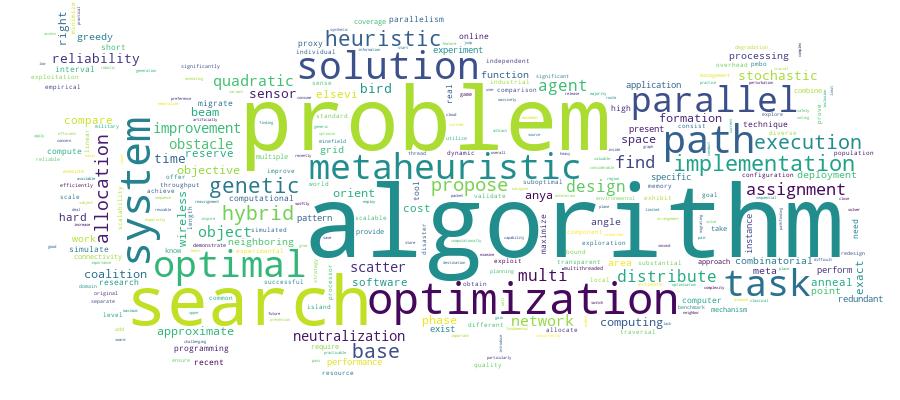
Competency Cloud
18 results
Scholarly Output Search Results
Now showing 1 - 10 of 18
Article Citation - WoS: 4Citation - Scopus: 3An optimal algorithm for the obstacle neutralization problem(American Institute of Mathematical Sciences PO Box 2604 Springfield MO 65801-2604, 2017) Ali Fuat Alkaya; Dindar Öz; Alkaya, Ali Fuat; Oz, DindarIn this study an optimal algorithm is presented for the obstacle neutralization problem (ONP). ONP is a recently introduced path planning problem wherein an agent needs to swiftly navigate from a source to a destination through an arrangement of obstacles in the plane. The agent has a limited neutralization capability in the sense that the agent can safely pass through an obstacle upon neutralization at a cost added to the traversal length. The goal of an agent is to find the sequence of obstacles to be neutralized en route minimizing the overall traversal length subject to the neutralization limit. Our optimal algorithm consists of two phases. In the first phase an upper bound of the problem is obtained using a suboptimal algorithm. In the second phase starting from the bound obtained from phase I a k-th shortest path algorithm is exploited to find the optimal solution. The performance of the algorithm is presented with computational experiments conducted both on real and synthetic naval minefield data. Results are promising in the sense that the proposed method can be applied in online applications. © 2017 Elsevier B.V. All rights reserved.Conference Object Using Proxy Design Pattern for Transparent Redundant Execution(Ceur-Ws, 2018) Öz, Sinan; Öz, Işıl; Öz, DindarConference Object An Improved Hybrid Genetic Algorithm for the Quadratic Assignment Problem(Institute of Electrical and Electronics Engineers Inc., 2021) Şeyda Melis Türkkahraman; Dindar ÖzThe quadratic assignment problem (QAP) is a well-known optimization problem that has many applications in various engineering areas. Due to its NP-hard nature rather than the exact methods heuristic and metaheuristic approaches are commonly adapted. In this study we propose an improved hybrid genetic algorithm which mainly combines a greedy heuristic and a simulated annealing algorithm with the classical genetic algorithm. We test our algorithm on the well-known benchmark for the QAP and compare the results with four different algorithms: a greedy algorithm simulated annealing algorithm (SA) demon algorithm (DA) and a classical genetic algorithm (GA). The results of the experiments validate that our hybridization significantly improves the performance of the algorithms comparing to their standalone executions. © 2022 Elsevier B.V. All rights reserved.Article Citation - WoS: 9Citation - Scopus: 9Scalable parallel implementation of migrating birds optimization for the multi-objective task allocation problem(SPRINGER, 2021) Dindar Oz; Isil Oz; Oz, Isil; Oz, DindarAs the distributed computing systems have been widely used in many research and industrial areas the problem of allocating tasks to available processors in the system efficiently has been an important concern. Since the problem is proven to be NP-hard heuristic-based optimization techniques have been proposed to solve the task allocation problem. Particularly the current cloud-based systems have been grown massively requiring multiple features like lower cost higher reliability and higher throughput, therefore the problem has become more challenging and approximate methods have gained more importance. Migrating birds optimization (MBO) algorithm offers successful solutions especially for quadratic assignment problems. Inspired by the movement of the birds it exhibits good results by its population-based approach . Since the algorithm needs to deal with many individuals in the population and the neighbor solution generation phase takes substantial time for large problem instances we need parallelism to have execution time improvements and make the algorithm practical for large-scale problems. In this work we propose a scalable parallel implementation of the MBO algorithm PMBO for the multi-objective task allocation problem. We redesigned the implementation of the MBO algorithm so that its computationally heavy independent tasks are executed concurrently in separate threads. We compare our implementation with three parallel island-based approaches. The experimental results demonstrate that our implementation exhibits substantial solution quality improvements for difficult problem instances as the computing resources namely parallelism increase. Our scalability analysis also presents that higher parallelism levels offer larger solution improvement for the PMBO over the island-based parallel implementations on very hard problem instances.Conference Object Ant Colony Optimization for the Sensor Deployment Problem(Institute of Electrical and Electronics Engineers Inc., 2023) Oz, DindarArticle Citation - WoS: 31Citation - Scopus: 43Optimal Any-Angle Path finding In Practice(AI ACCESS FOUNDATION, 2016) Daniel Harabor; Alban Grastien; Dindar Oz; Vural Aksakalli; Harabor, Daniel; Öz, Dindar; Grastien, Alban; Aksakalli, VuralAny-angle path finding is a fundamental problem in robotics and computer games. The goal is to find a shortest path between a pair of points on a grid map such that the path is not artificially constrained to the points of the grid. Prior research has focused on approximate online solutions. A number of exact methods exist but they all require super-linear space and pre-processing time. In this study we describe Anya: a new and optimal any-angle path finding algorithm. Where other works find approximate any-angle paths by searching over individual points from the grid Anya finds optimal paths by searching over sets of states represented as intervals. Each interval is identified on-the-fly. From each interval Anya selects a single representative point that it uses to compute an admissible cost estimate for the entire set. Anya always returns an optimal path if one exists. Moreover it does so without any offline pre-processing or the introduction of additional memory overheads. In a range of empirical comparisons we show that Anya is competitive with several recent (sub-optimal) online and pre-processing based techniques and is up to an order of magnitude faster than the most common benchmark algorithm a grid-based implementation of A*.Master Thesis Sanal makine yerleştirme problemi için çok amaçlı optimizasyon çözümü(2024) Altuntaş, Tolga Buğra; Öz, DindarDelivering different services over the Internet requires cloud computing. These services are managed by Cloud Service Providers using Virtual Machines that simulate physical machines in order to provide the required computing resources. Efficiently managing and allocating these resources is crucial for achieving optimal performance and cost-effectiveness. Nevertheless, the rapid expansion of cloud computing increased the complexity and scale of cloud environments. A key element of cloud computing is virtual machine placement (VMP), which makes sure that virtual machines are distributed among physical servers as efficiently as possible. Effective VMP strategies optimize data center performance and energy management, affecting operational cost and customer satisfaction. This work focuses on resource utilization and energy management on the multi-objective VMP problem. Extended Adapted Large Neighborhood Search (EALNS) algorithm is utilized to solve the problem. The EALNS algorithm uses a weight value to improve the spread of non-dominated solutions and create a better Pareto front. Five problem-specific destroy and repair operators are employed to adapt the EALNS algorithm to the VMP problem. To the best of our knowledge, this is the first work that uses the ALNS algorithm to solve a multi-objective VMP problem. The comparison experiments are done against three state-of-the-art multi-objective algorithms. The results show that the EALNS algorithm has great scalability and creates higher-quality Pareto fronts than its competitors.Conference Object Using proxy design pattern for transparent redundant execution, Saydam artıklı çalıştırma I çin vekil tasarım örüntüsü kullanımı(CEUR-WS ceurws@sunsite.informatik.rwth-aachen.de, 2018) Dindar Öz; Sinan Öz; Isil Oz; M. Erten , A. TarhanIn this study we propose a transparent model for reliable execution of object-oriented software. We design a generic object-oriented programming tool for redundant software execution to provide the desired level of reliability against transient hardware faults. To achieve this we utilize the Proxy design pattern which is one of the well-known GoF design patterns that are formed to make software systems flexible and easy to maintain. Proxy design pattern provides a controlled access and a transparent mechanism for adding new functionalities to an existing object when accessing it. Combining the instruments of dynamic proxy and annotations in Java programming language we present RedundantCaller a generic transparent and configurable tool for redundant execution and majority voting. Our tool takes any object and creates a dynamic proxy for it which executes the methods of the object multiple times in separate threads and performs majority voting on the background requiring minimum amount of change in the original user code. Thanks to annotations users can configure the redundant execution scheme methodwise. Our experiments demonstrate that our tool provides a significant level of reliability to any object-oriented software with a reasonable amount of performance degradation through multithreaded execution. © 2018 Elsevier B.V. All rights reserved.Article Optimal any-angle pathfinding in practice(AI Access Foundation minton@fetch.com, 2016) Daniel D. Harabor; Alban Grastien; Dindar Öz; Vural AksakalliAny-angle pathfinding is a fundamental problem in robotics and computer games. The goal is to find a shortest path between a pair of points on a grid map such that the path is not artificially constrained to the points of the grid. Prior research has focused on approximate online solutions. A number of exact methods exist but they all require super-linear space and pre-processing time. In this study we describe Anya: a new and optimal any-angle pathfinding algorithm. Where other works find approximate any-angle paths by searching over individual points from the grid Anya finds optimal paths by searching over sets of states represented as intervals. Each interval is identified on-the-fly. From each interval Anya selects a single representative point that it uses to compute an admissible cost estimate for the entire set. Anya always returns an optimal path if one exists. Moreover it does so without any offline pre-processing or the introduction of additional memory overheads. In a range of empirical comparisons we show that Anya is competitive with several recent (sub-optimal) online and pre-processing based techniques and is up to an order of magnitude faster than the most common benchmark algorithm a grid-based implementation of A∗. © 2016 Elsevier B.V. All rights reserved.Conference Object Citation - Scopus: 1Optimizing Wireless Sensor Network Deployment with Hybrid Genetic Algorithm(Institute of Electrical and Electronics Engineers Inc., 2023) Dogukan Teber; Efekan Zafer Engin; Dindar Öz; Engin, Efekan Zafer; Teber, Dogukan; Oz, DindarWireless Sensor Networks (WSNs) have vital applications in diverse domains including military environmental monitoring disaster management and security systems. Achieving both m-connectivity and k-coverage is critical for ensuring network reliability and effective area monitoring. In this study we propose a Hybrid Genetic Algorithm for Wireless Sensor Network deployment (HGA-WSN) that combines genetic algorithms with problem-specific local search to efficiently explore solutions. The paper compares HGA-WSN against a standard genetic algorithm a greedy heuristic and a standard simulated annealing implementation. The experiments encompass various problem instances considering different $\mathrm{m}\mathrm{k}$ and target count values. The results validate HGA-WSN's superior performance in terms of sensor count reduction. The algorithm's efficacy in optimizing WSN deployment across diverse applications is evident from its rapid convergence and enhanced connectivity and coverage achievements. © 2023 Elsevier B.V. All rights reserved.
