
Gökçe, Mahmut Ali
Loading...
Name Variants
Mahmut Ali Gökçe
Mahmut Ali Gokce
Mahmut Ali Gokce
Job Title
Dr.Öğr.Üyesi
Email Address
Main Affiliation
01.01.09.03. Endüstri Mühendisliği Bölümü
Status
Current Staff
Website
ORCID ID
Scopus Author ID
Turkish CoHE Profile ID
Google Scholar ID
WoS Researcher ID
Sustainable Development Goals
 1
1NO POVERTY
0
Research Products
 2
2ZERO HUNGER
0
Research Products
 3
3GOOD HEALTH AND WELL-BEING
0
Research Products
 4
4QUALITY EDUCATION
0
Research Products
 5
5GENDER EQUALITY
0
Research Products
 6
6CLEAN WATER AND SANITATION
0
Research Products
 7
7AFFORDABLE AND CLEAN ENERGY
2
Research Products
 8
8DECENT WORK AND ECONOMIC GROWTH
1
Research Products
 9
9INDUSTRY, INNOVATION AND INFRASTRUCTURE
6
Research Products
 10
10REDUCED INEQUALITIES
0
Research Products
 11
11SUSTAINABLE CITIES AND COMMUNITIES
10
Research Products
 12
12RESPONSIBLE CONSUMPTION AND PRODUCTION
1
Research Products
 13
13CLIMATE ACTION
0
Research Products
 14
14LIFE BELOW WATER
2
Research Products
 15
15LIFE ON LAND
0
Research Products
 16
16PEACE, JUSTICE AND STRONG INSTITUTIONS
0
Research Products
 17
17PARTNERSHIPS FOR THE GOALS
0
Research Products

Scopus data could not be loaded because of an error. Please refresh the page or try again later.

Documents
16
Citations
220

Scholarly Output
30
Articles
3
Views / Downloads
0/0
Supervised MSc Theses
3
Supervised PhD Theses
1
WoS Citation Count
160
Scopus Citation Count
232
Patents
0
Projects
0
WoS Citations per Publication
5.33
Scopus Citations per Publication
7.73
Open Access Source
4
Supervised Theses
4
| Journal | Count |
|---|---|
| 4th International Conference on Intelligent and Fuzzy Systems (INFUS) | 3 |
| International Conference on Intelligent and Fuzzy Systems INFUS 2022 | 3 |
| European Transport Research Review | 2 |
| 9th IFAC/IFIP/IFORS/IISE/INFORMS Conference on Manufacturing Modelling Management and Control (IFAC MIM) | 2 |
| International Symposium for Production Research ISPR 2020 | 2 |
Current Page: 1 / 4
Scopus Quartile Distribution
Quartile distribution chart data is not available
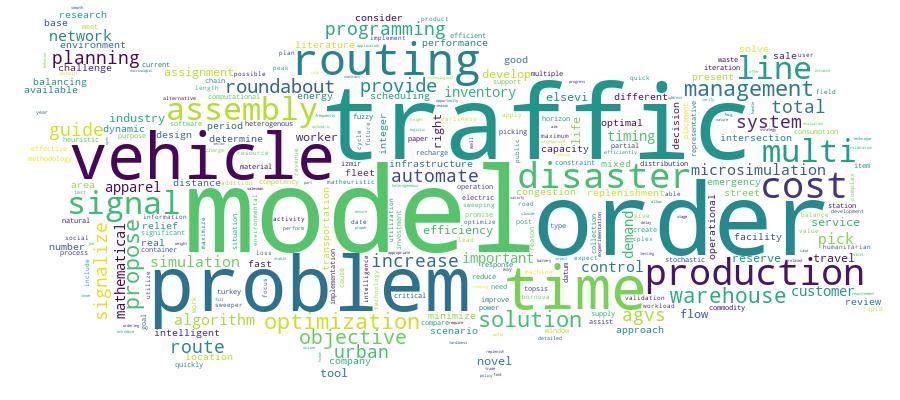
Competency Cloud
30 results
Scholarly Output Search Results
Now showing 1 - 10 of 30
Review Citation - WoS: 121Citation - Scopus: 186State-of-art review of traffic signal control methods: challenges and opportunities(SPRINGER, 2020) Syed Shah Sultan Mohiuddin Qadri; Mahmut Ali Gokce; Erdinc Oner; Gokce, Mahmut Ali; Qadri, Syed Shah Sultan Mohiuddin; Oner, ErdincIntroduction Due to the menacing increase in the number of vehicles on a daily basis abating road congestion is becoming a key challenge these years. To cope-up with the prevailing traffic scenarios and to meet the ever-increasing demand for traffic the urban transportation system needs effective solution methodologies. Changes made in the urban infrastructure will take years sometimes may not even be feasible. For this reason traffic signal timing (TST) optimization is one of the fastest and most economical ways to curtail congestion at the intersections and improve traffic flow in the urban network. Purpose Researchers have been working on using a variety of approaches along with the exploitation of technology to improve TST. This article is intended to analyze the recent literature published between January 2015 and January 2020 for the computational intelligence (CI) based simulation approaches and CI-based approaches for optimizing TST and Traffic Signal Control (TSC) systems provide insights research gaps and possible directions for future work for researchers interested in the field. Methods In analyzing the complex dynamic behavior of traffic streams simulation tools have a prominent place. Nowadays microsimulation tools are frequently used in TST related researches. For this reason a critical review of some of the widely used microsimulation packages is provided in this paper. Conclusion Our review also shows that approximately 77% of the papers included utilizes a microsimulation tool in some form. Therefore it seems useful to include a review categorization and comparison of the most commonly used microsimulation tools for future work. We conclude by providing insights into the future of research in these areas.Conference Object Citation - WoS: 6Citation - Scopus: 7A novel arc-routing problem of electric powered street sweepers with time windows and intermediate stops(Elsevier B.V., 2019) Cansu Yurtseven; Mahmut Ali Gökçe; Gokce, Mahmut Ali; Yurtseven, Cansu; D. Ivanov , A. Dolgui , F. YalaouiWaste collection is an important public service performed by municipalities. Powered street sweeping is an important part of waste collection. Recently electric powered street sweepers are used at an increasing rate for due to their energy efficiency. It is important to provide this public service at a minimum cost. We propose a novel mathematical model for determining routing of electric powered street sweepers considering a heterogeneous fleet with different capacities and battery levels to perform a predetermined service with realistic operational constraints. The objective is to minimize energy consumption used to provide the service travelling and disposal operations. © 2021 Elsevier B.V. All rights reserved.Conference Object Warehouse Design and Order Picking Algorithms for Apparel Industry(Springer Science and Business Media Deutschland GmbH, 2024) Deniz Su Güntekin; Egemen Şahin; Elif Ünlü; Nesrin Özbay; Mahmut Ali Gökçe; Simge Güçlükol Ergin; Güntekin, Deniz Su; Gökçe, Mahmut Ali; Şahin, Egemen; Ünlü, Elif; Özbay, Nesrin; Ergin, Simge Güçlükol; N.M. Durakbasa , M.G. GençyılmazWarehouse management has a critical role for success for the apparel industry. It is important because it ensures effective inventory control efficient order fulfillment optimal space utilization labor efficiency cost reduction and customer satisfaction which all directly effects the bottom line. A particularly important part of this optimization includes the design of the warehouse. In this study various product placement and order-picking scenarios have been studied in combination with numerous warehouse designs and implementation is presented for a large apparel company. The implementation was done in the warehouse of one of the largest Retail Textile Company specializing in women’s apparel production. First a comprehensive literature review was conducted for this study. As a result of the literature review different picking and routing algorithms were combined. The solution was developed first by building a simulation model. Different placement scenarios scenarios for assigning orders to workers and routing algorithms are presented in conjunction with warehouse designs. The aim is to reduce the total product placement and picking times and increase the efficiency of workers by utilizing different placement and picking algorithms. With this study the total placement and picking time is reduced by 36.56% compared to the current system. © 2024 Elsevier B.V. All rights reserved.Master Thesis Elektrikle çalışan sokak süpürücüleri için zaman pencereli ve ara duraklı ayrıt rotalama problemi(2019) Yurtseven, Cansu; Gökçe, Mahmut AliAtık toplama belediye hizmetleri içinde yer alır. Atık toplama problemleri gerçek hayatın içinden ve etkileri yüksek olduğundan, son zamanlarda bu problemler daha fazla çalışılmaya başlanmıştır. Atık toplama hizmetlerinin, karşılığında gelir olmadığından, kamu fonları ile minimum maliyetle gerçekleştirilmesi önemlidir. Sokak süpürme işlemi, belediye hizmetleri arasında atık yönetimi açısından önemli bir yer tutar. Son zamanlarda, elektrikli sokak süpürücüler, enerji verimlilikleri ve çevre koruma nedenleriyle artan bir oranda tercih edilmeye başlanmıştır. Bu çalışmada, atık boşaltım operasyonu, araç şarj planlaması, öğle yemeği ve dinlenme molaları gibi gerçekçi operasyonel kısıtları göz önünde bulundurarak, şehirdeki önceden belirlenmiş bir dizi sokağa hizmet vermek için elektrikle çalışan sokak süpürücülerinin rotalarını belirleme sorunu ele alınmaktadır. Sokak süpürme hizmetini gerçekleştirmek için farklı kapasitelere ve batarya seviyelerine sahip elektrikle çalışan heterojen bir araç filosunu ele alarak, verilen zaman pencereleri içerisinde süpürülme ihtiyacı olan caddelerden atıkları toplamak için, süpürücülerinin optimal rotalarını belirlemek amacıyla, yeni bir matematiksel model önerilmektedir. Kullanılan araçların zaman periyodunun başlangıcında bir depodan çıkması ve gün sonunda tekrar depoya geri dönmesi planlanmaktadır. Enazlanan amaç fonksiyonu, hizmeti kısıtlara göre sağlarken, seyahat ve atık boşaltım işlemlerinde kullanılan enerji tüketimini en aza indirmektir. Matematiksel modelin performansını ölçmek için, gerçek hayat örnekleri ile bir vaka çalışması ve deney tasarımı yapılmış, deney sonuçları incelenmiştir.Conference Object Intelligent Scheduling and Routing of a Heterogenous Fleet of Automated Guided Vehicles (AGVs) in a Production Environment with Partial Recharge(Springer Science and Business Media Deutschland GmbH, 2022) Selen Burçak Akkaya; Mahmut Ali Gökçe; C. Kahraman , S. Cevik Onar , B. Oztaysi , I.U. Sari , A.C. Tolga , S. CebiUse of Automated Guided Vehicles (AGVs) for material handling purposes has become increasingly popular. They introduce flexibility to the system by increasing the speed responsiveness and freight capacity as well as enabling increased productivity safety efficient resource utilization and reducing costs. These advantages can be realized by intelligent assignment of AGVs to jobs and routing of AGVs to meet production plans. We look at the problem of scheduling and routing of a heterogenous fleet of AGVs consisting of different types based on purpose of use freight and battery charge capacity used for handling transfer jobs in a production environment. The objective is to optimize the schedules and routes of AGVs by minimizing the penalty cost for the late delivery of a parts and energy consumption of the vehicles. To this end a novel mixed integer linear programming model for a heterogenous fleet of AGVs along with charging and energy consumption is proposed where partial recharging is allowed. Proposed model is validated and verified with a test case using IBM OPL CPLEX and results are provided. © 2022 Elsevier B.V. All rights reserved.Master Thesis Üretim ortamındaki otomatik yönlendirilmeli araçların (AGVs) çizelgeleme ve rotalama problemi için yeni bir senaryo temelli gürbüz çözüm yöntemi(2022) Akkaya, Selen Burçak; Gökçe, Mahmut AliOtomatik Yönlendirmeli Araçların (AGV'ler) malzeme taşıma amacıyla kullanımı giderek daha popüler hale gelmiştir. Hızlı ulaşım sağlamaları, görevlere hızlıca atanabilmeleri ve nakliye kapasitesini arttırmalarının yanı sıra üretkenlik, güvenlik, kaynakların kullanım verimini arttırarak ve maliyetleri azaltarak, sisteme esneklik kazandırmaktadırlar. Bu faydaların elde edilebilmesi için AGV'lerin işlere sistematik bir şekilde atanması ve AGV'lerin üretim planlarını karşılayacak şekilde rotalanması ve çizelgelenmesi gerekir. Bu tez, bir atölye üretim ortamında istasyonlar arası taşıma işlerini sağlamak amacıyla kullanılan, kullanım amacına, taşıma ve pil şarj kapasitesine göre farklı tiplerden oluşan heterojen bir AGV filosunun çizelgeleme ve rotalama problemini incelemektedir. Amaç, siparişlere ait taşıma işlerinin geç teslimine atanan ceza maliyetini ve araçların enerji tüketimini en aza indireren gürbüz bir atama ve AGV'lere ait gürbüz rotaları ve çizelgeleri bulmaktır. Bunun amaçla bu tez, heterojen bir AGV filosu için bu kararların yanı sıra şarj planı ve enerji tüketimini de gözeten, senaryo tabanlı yeni bir gürbüz karma tamsayılı doğrusal programlama modeli önerilerek literatüre katkıda bulunmaktadır. Önerilen model öncelikle, IBM OPL CPLEX kullanılarak bir test senaryosu ile doğrulanmıştır. Yapılan deney tasarımı ile önerilen modelin performansı ve belirli parametrelerin model üzerindeki etkisi değerlendirilmiştir.Conference Object Fuzzy TOPSIS and Goal Programming Approaches to Multi Objective Facility Location Problem for Emergency Goods and Services Distribution and Bornova/Izmir Case Study(Springer Science and Business Media Deutschland GmbH, 2022) Mert Paldrak; Simge Güçlükol Ergin; Mahmut Ali Gökçe; Melis Tan Tacoglu; Gökçe, Mahmut Ali; Tan Tacoğlu, Melis; Paldrak, Mert; Güçlükol, Simge; Tacoglu, Melis Tan; C. Kahraman , S. Cevik Onar , B. Oztaysi , I.U. Sari , A.C. Tolga , S. CebiDistributions of vital goods and services in emergency or post disaster situations are of paramount importance to be able to meet the requirements of those in need on time. Finding an appropriate location for facilities to distribute such goods and services efficiently and quickly is an important challenge. In such a situation location decisions for these facilities must be made quickly considering multiple objectives. This problem is a multi-objective facility location problem (MOFLP). The main focus of this study is to present two solution methodologies for a MOFLP in a post disaster situation. We specifically consider objective of minimizing maximum weighted distance traveled and minimizing total cost of facilities to be opened in order to satisfy all demand. We also provide a version of the problem when the number of facilities to be opened is limited and second objective becomes maximizing demand covered. Due to the conflicting nature of the objective functions we propose to apply Fuzzy TOPSIS and Goal Programming and compare the solutions obtained using these two techniques with respect to solution quality and computational time. We present the developed models and provide results from a real-life application using existing emergency assembly areas and current census data for Bornova/İzmir. This paper contributes in two ways to existing literature. First is the comparison between multiple (two) solution methodologies for MOPLP. Studies in the literature provide only one solution technique such as Fuzzy TOPSIS Goal Programming etc. Secondly we implement these methodologies by using real life data for emergency situations. © 2022 Elsevier B.V. All rights reserved.Doctoral Thesis Bağlantılı sinyalize dönel kavşaklar için sinyal sürelerinin optimizasyonu(2022) Qadri, Syed Shah Sultan Mohiuddin; Gökçe, Mahmut Ali; Öner, ErdinçManaging high traffic volumes and mitigating traffic congestion including slow-moving traffic at intersections from the urban traffic networks is the key challenge for urban administration. The increase in the number of vehicles on a daily basis in the urban network is causing a continuous deterioration in the traffic situation. This deterioration leads to many detrimental consequences on health, the economy, and the environment. Due to this, it is important to manage the flow of vehicles within these networks efficiently. As an effective intersection design, the roundabout is rapidly gaining attention and popularity among traffic engineers because of its capacity for the mobility of the number of vehicles. This capacity can further be improved through their signalization. The appropriate traffic signal timing concerning the traffic conditions is critical in providing smooth traffic flow. Inappropriate traffic signal timings not only cause delays and inconvenience to drivers but also increase environmental pollution due to excessive fuel consumption and the emission of greenhouse gases. Thus, it is important to investigate the different signal timings to ensure that implemented plan will improve the capacity and the performance of the network. The investigation can be conducted via either field testing or the use of a reliable simulation tool. As the microscopic simulation is safer, less expensive, and faster than field implementation and testing, which is why the simulation models are widely used in both transportation operations and management analysis. Many researchers have made an effort to improve the efficiency of traffic signals using different approaches. However, few studies have been done concerning traffic signal timings at roundabouts. Roundabouts have a different flow dynamic compared to regular intersections. With the increasing use of signalized roundabouts, especially in metropolitan areas, the traffic signal timings of roundabouts need to be studied. This dissertation introduces a simulation-based optimization framework for finding the optimal green phase timings of signal heads located at an isolated and a network of connected signalized roundabouts. In the developed framework, SUMO is used as a simulation tool whereas the genetic algorithm is used as an optimization algorithm. Two realistic simulation models for the roundabouts (isolated and the network) located in downtown Izmir, Turkey are also developed in order to test the frameworks' performances. The results of the proposed frameworks have been compared with the current settings and with Webster's results. It was found the proposed framework outperforms both the current settings and Webster in all performance measures that are outlined in this study.Conference Object Citation - Scopus: 1Multi Model Multiple Line Balancing Problem Modeling and Real-Life Application(Springer Science and Business Media Deutschland GmbH, 2021) Onur Orhan; Doğukan Başgöl; Muharrem Eren Tekin; Ahmet Gülseven; Mahmut Ali Gökçe; Evren Demir; Cansu Yurtseven; Orhan, Onur; Tekin, Muharrem Eren; Gökçe, Mahmut Ali; Demir, Evren; Yurtseven, Cansu; Gülseven, Ahmet; Başgöl, Doğukan; N.M. Durakbasa , M.G. GençyılmazThis study deals with multi-line balancing for multiple products. This problem originates from a real-life problem at a global heat boiler manufacturing company. The objective is to develop a solution method that enables create efficient line balances in a dynamic environment which maximizes the weighted average line efficiency and reduces waste of time for frequent line balancing procedures. Since weighted average efficiency is a key performance indicator for the company this paper focuses on the optimization of this measure. The proposed method is demonstrated with an implementation at three assembly lines where great majority of the company’s production takes place. For this problem an algorithm has been developed that creates a set of feasible scenarios (a scenario pool) in which total demand of each model is divided between available lines under capacity restrictions. For every scenario in the pool a custom multi model assembly line balancing MIP is created automatically and run. From the results best (most efficient) assignment of models’ demand to lines and corresponding line balances are obtained. Furthermore a user-friendly dynamic decision support system (DSS) is developed and proposed solution approaches are embedded in this DSS for the daily operations of the company. The developed DSS enables users to do an efficient line balancing in short computational time and provides the results with detailed line balancing reports. As this problem can be faced in various areas the proposed solution approaches can also be applied to different sectors and factories with little modification. © 2020 Elsevier B.V. All rights reserved.Conference Object Citation - Scopus: 1Matheuristic Algorithm for Automated Guided Vehicle (AGV) Assisted Intelligent Order Picking(Springer Science and Business Media Deutschland GmbH, 2023) Simge Güçlükol Ergin; Mahmut Ali Gökçe; Gökçe, Mahmut Ali; Ergin, Simge Güçlükol; C. Kahraman , I.U. Sari , B. Oztaysi , S. Cevik Onar , S. Cebi , A.C. TolgaWarehouse management plays an important role in the supply chain. It has received attention from academics and the industry for many years. During this time warehouse management processes have evolved like all other systems in the industry. Preparing orders faster has a key role for companies with an increasing demand from online shopping. The requirements for rapid response to customers have increased. Meanwhile the use of automated guided vehicles (AGVs) has increased because they are used to collect items by pickers in warehouses to prepare customer orders. Assignments of orders to AGVs and routing of AGVs should be done quickly and efficiently to prepare orders. Due to the NP-hardness of the problem it is difficult to solve realistic-size problems in an acceptable amount of time especially when orders from online shopping flow at a fast pace. In this study a new matheuristic algorithm was proposed to minimize the total traveled distance by all AGVs to collect orders with a minimum number of AGVs. This helps to reach a more sustainable system. Minimizing the distance of all AGVs helps for rapid responses to customers’ orders with minimum total energy/cost. Experimental results were provided to compare the computational complexities and performances of the models in this paper. The proposed novel matheuristic algorithm was shown to create intelligent order picking operations in warehouses within a reasonable computational time. © 2023 Elsevier B.V. All rights reserved.

- «
- 1 (current)
- 2
- 3
- »