
Örnek, Mustafa Arslan
Loading...

Name Variants
Mustafa Arslan Ornek
Job Title
Prof.Dr.
Email Address
Main Affiliation
01.01.09.03. Endüstri Mühendisliği Bölümü
Status
Former Staff
Website
ORCID ID
Scopus Author ID
Turkish CoHE Profile ID
Google Scholar ID
WoS Researcher ID
Sustainable Development Goals
 1
1NO POVERTY
0
Research Products
 2
2ZERO HUNGER
0
Research Products
 3
3GOOD HEALTH AND WELL-BEING
0
Research Products
 4
4QUALITY EDUCATION
0
Research Products
 5
5GENDER EQUALITY
0
Research Products
 6
6CLEAN WATER AND SANITATION
0
Research Products
 7
7AFFORDABLE AND CLEAN ENERGY
2
Research Products
 8
8DECENT WORK AND ECONOMIC GROWTH
0
Research Products
 9
9INDUSTRY, INNOVATION AND INFRASTRUCTURE
5
Research Products
 10
10REDUCED INEQUALITIES
0
Research Products
 11
11SUSTAINABLE CITIES AND COMMUNITIES
1
Research Products
 12
12RESPONSIBLE CONSUMPTION AND PRODUCTION
1
Research Products
 13
13CLIMATE ACTION
1
Research Products
 14
14LIFE BELOW WATER
0
Research Products
 15
15LIFE ON LAND
0
Research Products
 16
16PEACE, JUSTICE AND STRONG INSTITUTIONS
0
Research Products
 17
17PARTNERSHIPS FOR THE GOALS
1
Research Products

Documents
53
Citations
436
h-index
14

Documents
31
Citations
317

Scholarly Output
42
Articles
14
Views / Downloads
0/1
Supervised MSc Theses
2
Supervised PhD Theses
4
WoS Citation Count
43
Scopus Citation Count
66
Patents
0
Projects
0
WoS Citations per Publication
1.02
Scopus Citations per Publication
1.57
Open Access Source
4
Supervised Theses
6
| Journal | Count |
|---|---|
| Intelligent and Fuzzy Systems - Intelligence and Sustainable Future Proceedings of the INFUS 2023 Conference | 6 |
| Journal of the Operational Research Society | 3 |
| International Symposium for Production Research ISPR 2023 | 2 |
| Journal of Air Transport Management | 2 |
| 22nd International Symposium for Production Research ISPR 2022 | 2 |
Current Page: 1 / 5
Scopus Quartile Distribution
Quartile distribution chart data is not available
Competency Cloud
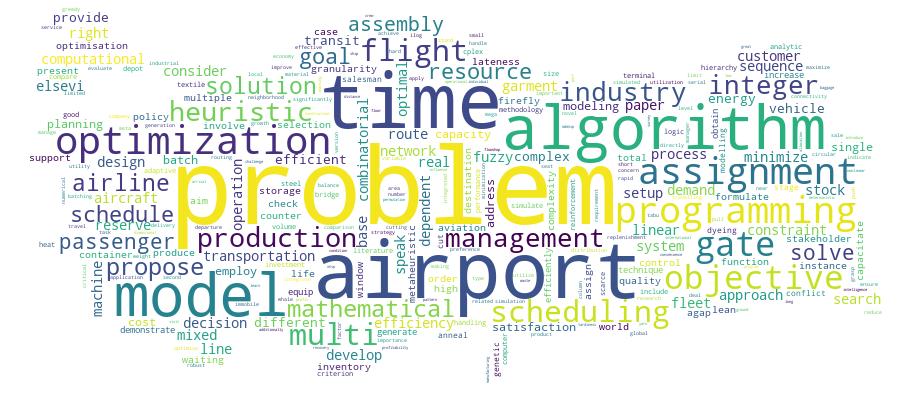
42 results
Scholarly Output Search Results
Now showing 1 - 10 of 42
Conference Object Mathematical Modeling Approach for Flight Timetable Generation with Return Flights and Airport Slot Capacity(Springer International Publishing AG, 2025) Tan Tacoglu, Melis; Ornek, Mustafa Arslan; Tacoglul, Melis Tan; Kazancoglu, YigitThis paper aims to generate a flight timetable between the hub and spokes, taking into account transit passenger waiting time at the hub and spokes in the pure-hub-and-spoke network. A non-linear mathematical model is developed to generate the flight timetable considering return flights, airport slot capacity, and passenger waiting time for the mega hub network. The results show that the decision to either rotate an arriving aircraft or dispatch a different aircraft has a crucial impact on passenger waiting times at both the destination and the hub. The aggregated demand at the hub, rather than individual origin-destination demand, plays a key role in determining the optimal schedule.Conference Object Citation - Scopus: 2A GRASP Algorithm for Multi-objective Airport Gate Assignment Problem(SPRINGER INTERNATIONAL PUBLISHING AG, 2022) Mert Paldrak; Mustafa Arslan Ornek; Paldrak, Mert; Ornek, Mustafa Arslan; DP Sakas; A Kavoura; P TomarasThe assignment of flights to appropriate gates is a complex combinatorial optimization problem that airport managers have to deal with every day. It is an important decision-making problem involving multiple and conflicting objectives. Considering the different stakeholders of the problem a multi-objective airport gate assignment problem is proposed and formulated as a Binary Integer Programming Model. This paper studies two main objectives namely maximizing total flight-to-gate assignment utility and minimizing total flight conflict probability. Unlike most of the mathematical models presented in the literature Airport Gate Assignment Problem is considered an over-constraint problem where flight-to-gate eligibility apron safety and night-stand flight constraints are involved. As a solution methodology a Greedy Randomized Adaptive Search Procedure (GRASP) algorithm on over-constrained AGAP is proposed since the algorithm produces a series of good features such as intuitive greedy appeals and is trivial to be efficiently implemented on parallel processors like gates. The paper aims to demonstrate the efficiency of the proposed solution methodology concerning determined objective functions.Article Citation - WoS: 7Citation - Scopus: 9An application of a circular economy approach to design an energy-efficient heat recovery system(ELSEVIER SCI LTD, 2021) S. Serhat Karakutuk; Sener Akpinar; M. Arslan Ornek; Akpinar, Sener; Ornek, M. Arslan; Karakutuk, S. SerhatThis paper aims to develop an optimal real-life energy-efficient design for a production plant within the concept of the circular economy. The problem is to install a Heat Recovery System (HRS) that utilizes the hot oil used by the compressors to heat the water for the central heating system. To achieve the desired level of energy efficiency this design problem must be formulated from both the optimization and sustainability points of view. Additionally this design problem must also consider the investment cost. In line with this purpose this paper formulates this design problem as an optimization problem employing a mathematical programming approach as a single objective and as a multi-objective optimization problem through a goal programming approach. Besides this paper uses the return on investment as a key performance indicator since it deals with a real-life design problem with an investment cost. The related design problem is solved with the single objective and multiobjective versions of the developed mathematical programming model via a commercial solver to identify different design alternatives and hence giving the decision-maker to make a selection option. Finally the capability of the developed mathematical programming model is tested on a set of randomly generated problems. The obtained results indicate that the developed mathematical programming model is a successful decision support system since its single and multi-objective versions are capable of identifying energy-efficient production designs within the context of the real-life problem on hand and the circular economy.Doctoral Thesis Havaalanı kaynaklarının pekiştirmeli öğrenme yöntemiyle sağlam planlanması çizelgelemesi(2025) Yıldız, Müge Muhafız; Örnek, Mustafa Arslan; Avcı, UmutBir havalimanının işletilmesi, birçok aktörün yer aldığı son derece karmaşık bir operasyondur. Havalimanı yönetiminin temel misyonu; tüm havayollarına, yer hizmetleri şirketlerine ve diğer hizmet sağlayıcılara yeterli kapasiteyi ve en iyi çalışma koşullarını sağlamaktır. Uçuş kapısı atama, havalimanı yönetiminin çözmesi gereken en temel planlama problemlerinden biridir; bu problem, gelen uçakların mevcut kapı veya park pozisyonlarına atanmasını ve aynı zamanda operasyonel kısıtların sağlanmasını içerir. Genellikle uçuşların varış ve kalkış zamanları deterministik olarak kabul edilmekte ve bu kombinatoryal problemi çözmek için çeşitli yöneylem araştırması yöntemleri kullanılmaktadır. Ancak, gerçek yaşam senaryolarında bu deterministik çözümler çoğu zaman uygulanabilir değildir. Çünkü uçuşların varış ve kalkış saatleri belirsizlik içermektedir. Bu belirsizliklerle başa çıkmak ve sağlam bir çizelgeleme oluşturmak büyük önem taşımaktadır. Bu çalışmada, uçuş kapısı atama problemini çözmek için Pekiştirmeli Öğrenme (PÖ) algoritmaları geliştirilmiştir; çünkü bu yöntem sıralı karar verme sürecine dayanmaktadır ve acil ya da sık değişen durumlara uyum sağlayabilen esnek çözümler üretmeye olanak tanımaktadır. Bu çalışmayla aynı kapıda ardışık atanmış uçaklar arasında boş zamanların toplamı olarak hesaplanan çizelgenin sağlamlığını maksimize etmeye ve aynı zamanda aprona atanan uçak sayısını minimize etmeyi hedefliyoruz. Geliştirdiğimiz çeşitli PÖ algoritmalarını amaç fonksiyonlar bakımından matematiksel modellerle karşılaştırıyoruz. Anahtar kelimeler: Uçak atama problemi, pekiştirmeli öğrenme, Q-öğrenme, derin öğrenme, sağlam çizelgelemeBook Part A Multi-objective Approach to Flight Scheduling and Fleet Assignment in Hub Network(Springer, 2025) Melis Tan Tacoglu; Mustafa Arslan Ornek; Cemalettin Öztürk; Ornek, Mustafa Arslan; Ozturk, Cemalettin; Tacoglu, Melis TanThe hub-and-spoke (HS) network is a widely used business strategy by airlines to optimize their operations and increase their reach by connecting multiple destinations through a central hub and the majority of the passengers are transit passengers. The airline schedule planning process starts with the flight scheduling problem (FSP) to generate a timetable in advance of six months. Then the fleet assignment problem (FAP) is examined to determine aircraft types. This sequential solution approach causes suboptimal solutions and the schedule must be adjusted to increased demand. Due to the complexity of this problem this study focuses specifically on incremental schedule design with one hub two-flight leg network. This study presents a Multi-Objective Mixed Integer Programming Model for integrated FSP and FAP to adjust the generated timetable with launching new flights. Two solution approaches are proposed to decide the new proposed flight’s time aircraft type and passenger assignment: the Weighted Goal Programming Model (WGPM) and the Lexicographic Goal Programming Model (LGPM). This study shows that there is a conflicting relationship between cost and C02 emissions in the flight scheduling process. If carbon dioxide emissions are prioritized airlines need to schedule more flights with small-capacity aircraft. © 2025 Elsevier B.V. All rights reserved.Conference Object Capacitated Vehicle Routing Problem with Time Windows(Springer Science and Business Media Deutschland GmbH, 2022) Aleyna Tanel; Begüm Kınay; Deniz Karakul; Efecan Özyörük; Elif İskifoğlu; Ezgi Özoğul; Meryem Ustaoğlu; Damla Yüksel; Mustafa Arslan Ornek; N.M. Durakbasa , M.G. GençyılmazSince distribution activities have great importance for firms supply management is a widely studied concept in many sectors. This study demonstrates an application of a Capacitated Vehicle Routing Problem with Time Windows (CVRPTW). The problem is in the form of a fixed destination multi depots visited by multi-travelling salesmen and the distance-travel time matrix is assumed to be asymmetric. The objective of the problem is to minimize the longest route time of each vehicle. This is achieved by developing a mixed-integer linear programming model (MILP) for the problem. Additionally since the problem is NP-hard a general heuristic method is developed to solve the problem for larger instances in negligible computational times. Results show that the balance between the individual route times of the vehicles is provided and the time window limit is ensured. The paper also discusses the results and presents concluding remarks. © 2022 Elsevier B.V. All rights reserved.Conference Object A Single Machine Job Scheduling Problem with Sequence Dependent Setup Times(Springer Science and Business Media Deutschland GmbH, 2021) Aylin Elibol; Selen Tosun; Emin Erbay; Egemen Orta; Öykü Gökşen; Asena Ceritoğlu; Çınar Arabacı; Hande Oztop; Mustafa Arslan Ornek; Ceritoğlu, Asena; Erbay, Emin; Örnek, Mustafa Arslan; Elibol, Aylin; Gökşen, Öykü; Tosun, Selen; Orta, Egemen; N.M. Durakbasa , M.G. GençyılmazIn this paper a real-life single machine job scheduling problem with sequence-dependent setup times of a hood manufacturer company is addressed to minimize total weighted tardiness of the jobs with given due dates. Initially a mixed-integer linear programming model is developed for the problem. Since the problem is NP-hard heuristic algorithms are also proposed to solve larger instances. Namely Apparent Tardiness Cost with Setups (ATCS) Earliest Due Date (EDD) Weighted Earliest Due Dates (WEDD) Shortest Processing Time (SPT) and Weighted Shortest Processing Time (WSPT) rule-based algorithms are developed for the problem. A swap move-based improvement is also employed in the proposed heuristic algorithms. To evaluate the effectiveness and efficiency of the proposed solution approaches a comprehensive computational study is conducted by developing instances for the problem using the methodology from the related literature. Initially optimal results are obtained for small instances by solving the mathematical model. Then the performance of the proposed heuristic algorithms is evaluated by comparisons with the optimal results and time-limited model results. The computational results show that proposed ATCS rule-based heuristic is very effective to solve the problem. A user-friendly decision support system (DSS) is also developed to serve users with easy and efficient job scheduling. © 2020 Elsevier B.V. All rights reserved.Article Citation - WoS: 2Citation - Scopus: 2Heuristic methods for integrated incremental schedule design and fleet assignment problem for hub and spoke network(Inderscience Publishers, 2024) Melis Tan Tacoglu; Mustafa Arslan Ornek; Yigit Kazancoglu; Ornek, M. Arslan; Tacoglu, Melis Tan; Kazancoglu, YigitManaging airline inbound and outbound schedules among passenger demand and aircraft utility complexity are addressed through three proposed heuristic methods for integrated schedule design and fleet assignment problem (ISDFAP) in single-hub two-flight leg hub-and-spoke networks. The second heuristic considering waiting time and available seat capacity contrasts with the first focusing only on waiting time for passenger-flight assignments. Meanwhile the third heuristic considers aircraft buffer time and stay time restrictions at the destination. Comparing the first two heuristics reveals that considering seat availability does not reduce waiting time. Flight departure time adjustments and overall timetable changes depend significantly on buffer time and wait time criteria. © 2024 Elsevier B.V. All rights reserved.Article Citation - WoS: 2Citation - Scopus: 2A two-stage real world serial batching scheduling problem: a case study(TAYLOR & FRANCIS LTD, 2024) Sadik Serhat Karakutuk; Sener Akpinar; Mustafa Arslan Ornek; Akpinar, Sener; Ornek, Mustafa Arslan; Karakutuk, Sadik SerhatThis paper concerns a real-life production management problem composed of two stages which includes interdependent batch scheduling problems. Moreover both stages require setup operations at the beginning and between the subsequent batches. From the optimisation point of view this production management problem is complying with customers' deadlines and hence minimising total lateness. To achieve this objective the production planner must identify optimum or near-optimum batch schedules for both stages. Correspondingly this paper aims to develop a methodology to manage the related production problem as accurately as possible. We formulate an optimisation model that employs the mathematical programming method in line with this. Afterwards an algorithmic proposal based on the simulated annealing algorithm is also developed to solve the problem in realistic sizes. The computational capabilities of the developed model and the algorithm are evaluated on the randomly generated problem sets. A direct comparison between the mathematical model and the algorithm shows how efficiently the proposed algorithm solves real-world problems. Also computational results indicate that the proposed algorithm satisfactorily solves the related real-world batch scheduling problem.Conference Object Fuzzy Model for Multi-objective Airport Gate Assignment Problem(Springer Science and Business Media Deutschland GmbH, 2023) Mert Paldrak; Melis Tan Tacoglu; Mustafa Arslan Ornek; Paldrak, Mert; Örnek, Mustafa Arslan; Tacoglu, Melis Tan; C. Kahraman , I.U. Sari , B. Oztaysi , S. Cevik Onar , S. Cebi , A.C. TolgaTo address the increasing demand for air transportation the management allocation and efficient utilization of limited airport resources such as bridge-equipped gates are of paramount importance to improve the efficiency of the air transportation system. Bridge-equipped gates are scarce and immobile resources have a significant impact on airport management airlines and passenger convenience when utilized properly. Hence the gate assignment problem is an important problem involving multiple stakeholders with conflicting objectives. This study proposes a fuzzy model to tackle two objectives: maximization of overall utility of flight-gate assignments and maximization of the robustness of the assignment schedule simultaneously. Fuzzy variables are employed in order to represent the uncertainty of idle times between two consecutive flights served by the same bridge-equipped gate and their membership degrees express their effect on assignment robustness. An adjustment function is applied to combine these two objective functions into one. To handle this NP-hard problem in a reasonable amount of computational time a constructive heuristic algorithm is employed. The performance of the proposed fuzzy model is evaluated with the help of various test in instances of different sizes Two fuzzy distribution functions are tested and their comparison is provided. The simulation results demonstrate the applicability and effectiveness of the fuzzy model in addressing multi-objective airport gate assignment problem. © 2023 Elsevier B.V. All rights reserved.
