
Akkaya, Selen Burçak
Loading...

Name Variants
Selen Burçak Akkaya
Job Title
Araş.Gör.
Email Address
Main Affiliation
01.01.09.03. Endüstri Mühendisliği Bölümü
Status
Former Staff
Website
ORCID ID
Scopus Author ID
Turkish CoHE Profile ID
Google Scholar ID
WoS Researcher ID
Sustainable Development Goals
SDG data is not available

Documents
3
Citations
12
h-index
2

Documents
1
Citations
7

Scholarly Output
5
Articles
0
Views / Downloads
0/0
Supervised MSc Theses
1
Supervised PhD Theses
0
WoS Citation Count
7
Scopus Citation Count
12
Patents
0
Projects
0
WoS Citations per Publication
1.40
Scopus Citations per Publication
2.40
Open Access Source
0
Supervised Theses
1
| Journal | Count |
|---|---|
| 22nd International Symposium for Production Research ISPR 2022 | 2 |
| 4th International Conference on Intelligent and Fuzzy Systems (INFUS) | 1 |
| International Conference on Intelligent and Fuzzy Systems INFUS 2022 | 1 |
Current Page: 1 / 1
Scopus Quartile Distribution
Quartile distribution chart data is not available
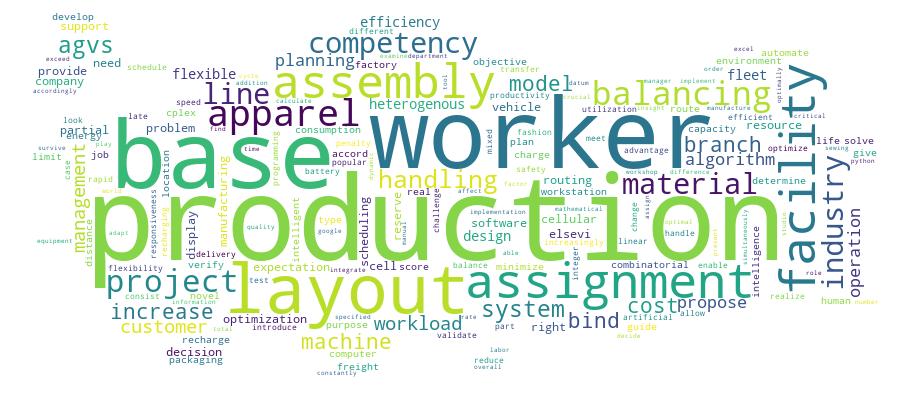
Competency Cloud
5 results
Scholarly Output Search Results
Now showing 1 - 5 of 5
Conference Object Intelligent Scheduling and Routing of a Heterogenous Fleet of Automated Guided Vehicles (AGVs) in a Production Environment with Partial Recharge(Springer Science and Business Media Deutschland GmbH, 2022) Selen Burçak Akkaya; Mahmut Ali Gökçe; C. Kahraman , S. Cevik Onar , B. Oztaysi , I.U. Sari , A.C. Tolga , S. CebiUse of Automated Guided Vehicles (AGVs) for material handling purposes has become increasingly popular. They introduce flexibility to the system by increasing the speed responsiveness and freight capacity as well as enabling increased productivity safety efficient resource utilization and reducing costs. These advantages can be realized by intelligent assignment of AGVs to jobs and routing of AGVs to meet production plans. We look at the problem of scheduling and routing of a heterogenous fleet of AGVs consisting of different types based on purpose of use freight and battery charge capacity used for handling transfer jobs in a production environment. The objective is to optimize the schedules and routes of AGVs by minimizing the penalty cost for the late delivery of a parts and energy consumption of the vehicles. To this end a novel mixed integer linear programming model for a heterogenous fleet of AGVs along with charging and energy consumption is proposed where partial recharging is allowed. Proposed model is validated and verified with a test case using IBM OPL CPLEX and results are provided. © 2022 Elsevier B.V. All rights reserved.Master Thesis Üretim ortamındaki otomatik yönlendirilmeli araçların (AGVs) çizelgeleme ve rotalama problemi için yeni bir senaryo temelli gürbüz çözüm yöntemi(2022) Akkaya, Selen Burçak; Gökçe, Mahmut AliOtomatik Yönlendirmeli Araçların (AGV'ler) malzeme taşıma amacıyla kullanımı giderek daha popüler hale gelmiştir. Hızlı ulaşım sağlamaları, görevlere hızlıca atanabilmeleri ve nakliye kapasitesini arttırmalarının yanı sıra üretkenlik, güvenlik, kaynakların kullanım verimini arttırarak ve maliyetleri azaltarak, sisteme esneklik kazandırmaktadırlar. Bu faydaların elde edilebilmesi için AGV'lerin işlere sistematik bir şekilde atanması ve AGV'lerin üretim planlarını karşılayacak şekilde rotalanması ve çizelgelenmesi gerekir. Bu tez, bir atölye üretim ortamında istasyonlar arası taşıma işlerini sağlamak amacıyla kullanılan, kullanım amacına, taşıma ve pil şarj kapasitesine göre farklı tiplerden oluşan heterojen bir AGV filosunun çizelgeleme ve rotalama problemini incelemektedir. Amaç, siparişlere ait taşıma işlerinin geç teslimine atanan ceza maliyetini ve araçların enerji tüketimini en aza indireren gürbüz bir atama ve AGV'lere ait gürbüz rotaları ve çizelgeleri bulmaktır. Bunun amaçla bu tez, heterojen bir AGV filosu için bu kararların yanı sıra şarj planı ve enerji tüketimini de gözeten, senaryo tabanlı yeni bir gürbüz karma tamsayılı doğrusal programlama modeli önerilerek literatüre katkıda bulunmaktadır. Önerilen model öncelikle, IBM OPL CPLEX kullanılarak bir test senaryosu ile doğrulanmıştır. Yapılan deney tasarımı ile önerilen modelin performansı ve belirli parametrelerin model üzerindeki etkisi değerlendirilmiştir.Conference Object Assembly Line and Workload Balancing with Competency-Based Worker Assignment in Apparel Production(Springer Science and Business Media Deutschland GmbH, 2023) Yiğit Efe Bilir; Benay Dişbudak; Oğuzhan Aydın; Emre Demirhisar; Burçak Sena Koçak; Yusuf Durğay; Selen Burçak Akkaya; Mahmut Ali Gökçe; Gökçe, Mahmut Ali; Durğay, Yusuf; Aydın, Oğuzhan; Dişbudak, Benay; Demirhisar, Emre; Bilir, Yiğit Efe; Koçak, Burçak Sena; N.M. Durakbasa , M.G. GençyılmazThe apparel industry is challenging for production management due to rapid changes in fashion. Accordingly customer needs and expectations increase constantly. As a result apparel factories must be able to increase production rate efficiency and quality in order to survive in this dynamic world. To this end assembly line balancing which affects the overall cost and efficiency in apparel industry plays a critical role. In this study real-life assembly line balancing and competency-based worker assignment problems in apparel industry sewing workshop are examined simultaneously and implementation at a big apparel company is presented. A novel mathematical model is proposed to solve this integrated problem. Operation-worker and operation-workstation assignments are made for a given number of workstations operations and workers. The competency score of the worker on each machine type is a key factor in determining worker-operation assignment. Assignments are made in such a way that the total competency score of the line must exceed a pre-specified limit. The objective is to minimize the workload difference between workers on the assembly line for a given cycle time limit. The proposed model is solved using Google OR-Tools and is verified using real-life data from the company. Since the competency of the workers is crucial in operations based on manual labor the proposed model can also be adapted to many industries in addition to the apparel industry. © 2024 Elsevier B.V. All rights reserved.Conference Object Citation - WoS: 7Citation - Scopus: 10Intelligent Scheduling and Routing of a Heterogenous Fleet of Automated Guided Vehicles (AGVs) in a Production Environment with Partial Recharge(SPRINGER INTERNATIONAL PUBLISHING AG, 2022) Selen Burcak Akkaya; Mahmut Ali Gokce; Gokce, Mahmut Ali; Akkaya, Selen Burcak; C Kahraman; AC Tolga; SC Onar; S Cebi; B Oztaysi; IU SariUse of Automated Guided Vehicles (AGVs) for material handling purposes has become increasingly popular. They introduce flexibility to the system by increasing the speed responsiveness and freight capacity as well as enabling increased productivity safety efficient resource utilization and reducing costs. These advantages can be realized by intelligent assignment of AGVs to jobs and routing of AGVs to meet production plans. We look at the problem of scheduling and routing of a heterogenous fleet of AGVs consisting of different types based on purpose of use freight and battery charge capacity used for handling transfer jobs in a production environment. The objective is to optimize the schedules and routes of AGVs by minimizing the penalty cost for the late delivery of a parts and energy consumption of the vehicles. To this end a novel mixed integer linear programming model for a heterogenous fleet of AGVs along with charging and energy consumption is proposed where partial recharging is allowed. Proposed model is validated and verified with a test case using IBM OPL CPLEX and results are provided.Conference Object Citation - Scopus: 2A Flexible Facility Layout Design for a Project-Based Production System(Springer Science and Business Media Deutschland GmbH, 2023) Elif Ceyhan; Yaren Özkan; Elif Şener; Gül Zozan Çetin; Hilal Toptanış; Özge Sevim Aykut; Selen Burçak Akkaya; Erdinc Oner; Çetin, Gül Zozan; Aykut, Özge Sevim; Özkan, Yaren; Öner, Erdinç; Ceyhan, Elif; Toptanış, Hilal; Şener, Elif; N.M. Durakbasa , M.G. GençyılmazIn this study the facility layout of a packaging machine production factory is planned according to the costs of the material handling equipment and distances between the departments. The branch and bound algorithm are implemented to optimally find the cells to be assigned for the projects. Costs are calculated in Excel and an optimal layout is developed in the facility according to the distances and the material handling costs information provided by the company. Moreover a decision support system is developed to display a flexible facility layout design for a project-based production system which provides insight for the managers to decide the locations of packaging machine production cells. The locations of the projects to the manufacturing cells are determined by using the algorithms and models using the Python and OPL CPLEX 12.10 Optimization Studio software. © 2023 Elsevier B.V. All rights reserved.
