
Çavka, Hasan Burak
Loading...

Name Variants
Hasan Burak Cavka
Job Title
Dr.Öğr.Üyesi
Email Address
Main Affiliation
01.01.10.02. Mimarlık Bölümü
Status
Former Staff
Website
ORCID ID
Scopus Author ID
Turkish CoHE Profile ID
Google Scholar ID
WoS Researcher ID
Sustainable Development Goals
 1
1NO POVERTY
0
Research Products
 2
2ZERO HUNGER
0
Research Products
 3
3GOOD HEALTH AND WELL-BEING
0
Research Products
 4
4QUALITY EDUCATION
0
Research Products
 5
5GENDER EQUALITY
0
Research Products
 6
6CLEAN WATER AND SANITATION
0
Research Products
 7
7AFFORDABLE AND CLEAN ENERGY
1
Research Products
 8
8DECENT WORK AND ECONOMIC GROWTH
0
Research Products
 9
9INDUSTRY, INNOVATION AND INFRASTRUCTURE
0
Research Products
 10
10REDUCED INEQUALITIES
0
Research Products
 11
11SUSTAINABLE CITIES AND COMMUNITIES
0
Research Products
 12
12RESPONSIBLE CONSUMPTION AND PRODUCTION
0
Research Products
 13
13CLIMATE ACTION
0
Research Products
 14
14LIFE BELOW WATER
0
Research Products
 15
15LIFE ON LAND
0
Research Products
 16
16PEACE, JUSTICE AND STRONG INSTITUTIONS
0
Research Products
 17
17PARTNERSHIPS FOR THE GOALS
1
Research Products

This researcher does not have a Scopus ID.

Documents
9
Citations
274

Scholarly Output
3
Articles
3
Views / Downloads
0/0
Supervised MSc Theses
0
Supervised PhD Theses
0
WoS Citation Count
21
Scopus Citation Count
24
Patents
0
Projects
0
WoS Citations per Publication
7.00
Scopus Citations per Publication
8.00
Open Access Source
1
Supervised Theses
0
| Journal | Count |
|---|---|
| Journal of Information Technology in Construction | 1 |
| Journal of Integrated Design and Process Science | 1 |
Current Page: 1 / 1
Scopus Quartile Distribution
Quartile distribution chart data is not available
Competency Cloud
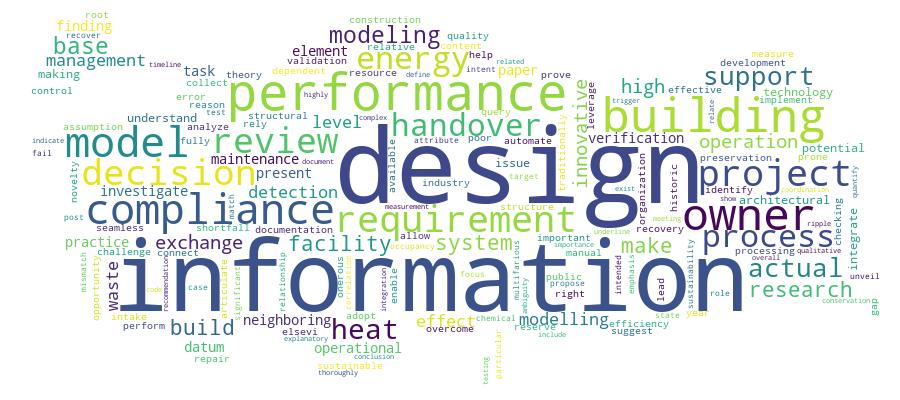
3 results
Scholarly Output Search Results
Now showing 1 - 3 of 3
Article LEVELS OF BIM COMPLIANCE FOR MODEL HANDOVER(INT COUNCIL RESEARCH & INNOVATION BUILDING & CONSTRUCTION, 2018) Hasan Burak Cavka; Sheryl Staub-French; Erik A. PoirierThe important process of design review compliance checking and project handover information intake and processing have traditionally been paper based and manual tasks. These tasks are onerous and error prone. Moreover they do not allow effective detection of design issues and validation of project information quality for handover which lead to waste of resources when performing maintenance and repairs during operations. Building Information Modeling has the potential to help owners overcome these challenges by enabling seamless exchange of project information between design construction and operations while supporting and proving opportunities for automated design reviews. However this practice has yet to fully take root in the industry due to its relative novelty. The research project presented in this paper set out to understand how owners could adopt and implement BIM to support design and information handover review. Two large public owner organizations were investigated over five years to support this aim. The findings are articulated around three levels of compliance for the owner's project and BIM requirements. The findings on compliance review suggest three elements: model structure verification model content verification and design compliance review. These three elements rely on model queries which are identified through investigation of owner's operational requirements. The presented research connects modeling practice to support facilities maintenance owner's information requirements and owner's design requirements and leverages this information for model based compliance review.Article Citation - WoS: 6Citation - Scopus: 6An investigation of the design process's effect on a high-performance building's actual energy system performance(IOS Press BV, 2022) Belgin Terim Cavka; Hasan Burak Cavka; Mohammad Mahdi Salehi; Cavka, Belgin Terim; Salehi, M. Mahdi; Terim Cavka, Belgin; Cavka, Hasan B.The design intent and the performance targets of projects may sometimes fail to match a building's actual post-occupancy performance. The mismatch of intended and actual building performance can be attributed to multifarious reasons. This study focuses on the role of project decisions made during design as one of the reasons of shortfall. The aim of the study is to unveil the design decision-making process of a state-of-the-art research building through the analysis of project's available set of IDP (Integrated Design Process) documentation. To understand the relationship and correlation between the energy performance gap and the decision-making process of the case building we investigated the design decisions' effect on the actual performance. The particular emphasis is on the decisions that were based on assumptions rather than measured actual test data for the proposed innovative building systems. The designed heat recovery system which was dependent on recovered heat from the neighboring research building had a significant effect on the building's poor energy performance. We investigated collected project data from coordination meetings thoroughly analyzed project documentation and quantified the building's actual energy performance data. The analysis of the project information shows the ripple effect of decisions that were made based on assumptions that triggered shortfalls in the building's overall actual performance. Our qualitative analysis indicates that the poor system performance during operations was related with the design decisions that were not based on the measurement of the actual performance of the existing systems in the neighboring building. The performance of the heat recovery from the neighboring building as a highly dependent Energy Conservation Measure (ECM) analyzed through collected documents and data. The ambiguity of the available heat potential from the neighboring building and related testing issues defined on an explanatory timeline of process coding. The conclusion includes recommendations for the design decision-making process for innovative system integrations for high-performance buildings and underlines the importance of IDP for complex buildings. © 2023 Elsevier B.V. All rights reserved.Article Citation - WoS: 15Citation - Scopus: 18Levels of BIM compliance for model handover(Department of Computer Science, 2018) Hasan Burak Cavka; Sheryl Staub-French; Erik A. Poirier; Poirier, Erik A.; Burak Cavka, Hasan; Cavka, Hasan Burak; Staub-French, SherylThe important process of design review compliance checking and project handover information intake and processing have traditionally been paper based and manual tasks. These tasks are onerous and error prone. Moreover they do not allow effective detection of design issues and validation of project information quality for handover which lead to waste of resources when performing maintenance and repairs during operations. Building Information Modeling has the potential to help owners overcome these challenges by enabling seamless exchange of project information between design construction and operations while supporting and proving opportunities for automated design reviews. However this practice has yet to fully take root in the industry due to its relative novelty. The research project presented in this paper set out to understand how owners could adopt and implement BIM to support design and information handover review. Two large public owner organizations were investigated over five years to support this aim. The findings are articulated around three levels of compliance for the owner’s project and BIM requirements. The findings on compliance review suggest three elements: model structure verification model content verification and design compliance review. These three elements rely on model queries which are identified through investigation of owner’s operational requirements. The presented research connects modeling practice to support facilities maintenance owner’s information requirements and owner’s design requirements and leverages this information for model based compliance review. © 2019 Elsevier B.V. All rights reserved.
