Akaltun Akan, Evren

Loading...
Profile Picture
Name Variants
Evren Akaltun Akan
Job Title
Dr.Öğr.Üyesi
Email Address
Main Affiliation
01.01.05.01. İngiliz Dili ve Edebiyatı Bölümü
Status
Current Staff
Website
Scopus Author ID
Turkish CoHE Profile ID
Google Scholar ID
WoS Researcher ID

Sustainable Development Goals

SDG data is not available
Documents

2

Citations

1

h-index

1

Documents

4

Citations

11

Scholarly Output

4

Articles

4

Views / Downloads

0/0

Supervised MSc Theses

0

Supervised PhD Theses

0

WoS Citation Count

0

Scopus Citation Count

0

Patents

0

Projects

0

WoS Citations per Publication

0.00

Scopus Citations per Publication

0.00

Open Access Source

1

Supervised Theses

0

JournalCount
The European Legacy2
Cankaya University Journal of Humanities and Social Sciences1
Journal of World Literature1
Current Page: 1 / 1

Scopus Quartile Distribution

Quartile distribution chart data is not available

Competency Cloud

GCRIS Competency Cloud

Scholarly Output Search Results

Now showing 1 - 4 of 4
  • Article
    Mahmoud Darwish's Memory for Forgetfulness: Redeeming Worldliness through Exilic Consciousness
    (ROUTLEDGE JOURNALS TAYLOR & FRANCIS LTD, 2020) Evren Akaltun Akan; Akan, Evren Akaltun
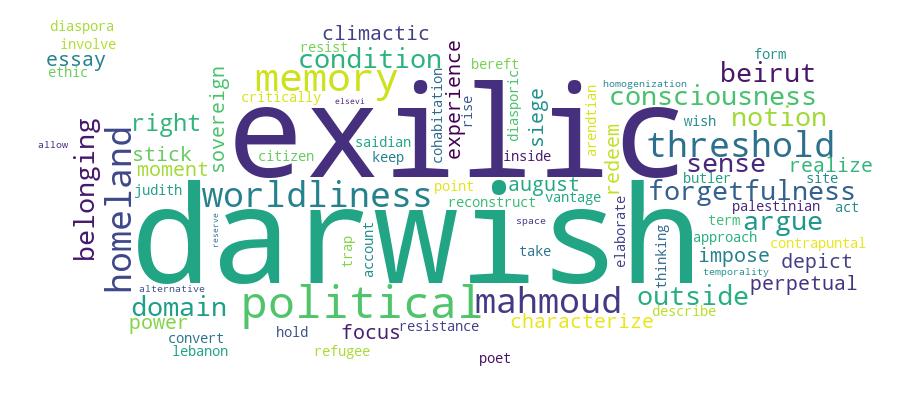
    This essay focuses on Mahmoud Darwish's exilic experience as depicted in Memory for Forgetfulness: August Beirut 1982 (1986). For Darwish the siege of Beirut was a climactic moment in which he realized that he is stuck on a perpetual threshold. Imposed by the sovereign power this exilic threshold characterizes the Palestinian refugees in Lebanon bereft of their rights as citizens and held outside their homeland and political domain. I wish to argue that rather than being trapped in this condition Darwish takes it as a vantage point to critically reconstruct the notions of homeland and political belonging. This involves a contrapuntal approach to the notions of homeland diaspora and memory and acts as a form of resistance. It converts the exilic threshold that keeps the poet neither outside nor inside the political domain into a site of worldliness in both the Arendtian and Saidian sense of the term. Elaborating on Judith Butler's account of cohabitation and diasporic thinking I argue that the exilic condition Darwish describes can give rise to a political ethic that resists the homogenization of spaces and temporalities and allows for an alternative sense of political belonging.
  • Article
    Orlando Romanında Oluşumlar: Zamansallık Yazarlık ve Kuir Olmak
    (2023) Evren Akaltun; Akaltun, Evren
    Bu makale Virginia Woolf’un Orlando: Bir Yaşam Öyküsü (1928) eserindeki kuirlik oluş hali ve yazma eylemi arasındaki ilişkiye odaklanmaktadır. Burada kullanılan “oluş” kavramı kadınlar tarafından ve kadınlar üzerine yazma eyleminde işlev gören çeşitli mekanizmalarla beraber kuirlik ve zaman arasındaki ilişkiyi göstermek için kullanılmaktadır. Kuirlik ve oluş monolitik olmayan bir cinsiyet anlayışına işaret eder ve her iki kavram da cinsiyet ikilikleri etrafında inşa edilmiş heteronormatif normları bozarak bireyin dönüştürücü kabiliyetlerindeki potansiyele dikkat çeker. Kuirlik bir “oluş” biçimi olarak cinsiyet ikiliği etrafında kurulmuş olan sabit normları bozma kapasitesiyle zamanla yakından ilintilidir çünkü kuirlik çizgisel zaman anlayışını da bozar. Zaman algısı Woolf’un romanının özellikle son bölümünde bir yazar ve bir kadın olarak kişinin varoluşunu anlaması açısından son derece önemlidir. Bu yazarın çağının yazarı olmak amacıyla yakalamak istediği içinde çeşitlilik barındıran şimdiki zamanın modernite ânıdır. Romanın tamamına ana karakter Orlando’nun kendisinin yazmakta olduğu metni tamamlama ve yazarı olmaya yönelik çabası nüfuz etmektedir. Orlando Deleuze’ün işaret ettiği anlamda “kadın-olurken ” aynı zamanda yazmakta olduğu “The Oak Tree” metninin de yazarı haline gelir. Böylelikle bu çalışmada savunulduğu gibi Orlando yalnız kuirliği başka bir deyişle zamanla olan eşitsiz ilişkisi sayesinde yazma eylemini başararak bir yazar olabilir ve ironik bir biçimde içinde bulunduğu zamanı yakalar.
  • Article
    Mahmoud Darwish’s Memory for Forgetfulness: Redeeming Worldliness through Exilic Consciousness
    (Routledge info@tandf.co.uk, 2020) Evren Akaltun Akan
    This essay focuses on Mahmoud Darwish’s exilic experience as depicted in Memory for Forgetfulness: August Beirut 1982 (1986). For Darwish the siege of Beirut was a climactic moment in which he realized that he is stuck on a perpetual threshold. Imposed by the sovereign power this exilic threshold characterizes the Palestinian refugees in Lebanon bereft of their rights as citizens and held outside their homeland and political domain. I wish to argue that rather than being trapped in this condition Darwish takes it as a vantage point to critically reconstruct the notions of homeland and political belonging. This involves a contrapuntal approach to the notions of homeland diaspora and memory and acts as a form of resistance. It converts the exilic threshold that keeps the poet neither outside nor inside the political domain into a site of worldliness in both the Arendtian and Saidian sense of the term. Elaborating on Judith Butler’s account of cohabitation and diasporic thinking I argue that the exilic condition Darwish describes can give rise to a political ethic that resists the homogenization of spaces and temporalities and allows for an alternative sense of political belonging. © 2020 Elsevier B.V. All rights reserved.
  • Review
    In Quest of Ourselves: A Highly Important Matter
    (Brill Academic Publishers, 2020) Ahmet Hamdi Tanpinar; Evren Akaltun; Trevor Hope; Akaltun, Evren; Hope, Trevor; Tanpinar, Ahmet Hamdi
    [No abstract available]