Özgü, Can

Loading...
Profile Picture
Name Variants
Özgü Can
Ozgu Can
Job Title
Dr.Öğr.Üyesi
Email Address
Main Affiliation
01.01.05.01. İngiliz Dili ve Edebiyatı Bölümü
Status
Current Staff
Website
Scopus Author ID
Turkish CoHE Profile ID
Google Scholar ID
WoS Researcher ID

Sustainable Development Goals

SDG data is not available
Documents

2

Citations

1

h-index

1

Documents

2

Citations

0

Scholarly Output

4

Articles

2

Views / Downloads

0/0

Supervised MSc Theses

0

Supervised PhD Theses

0

WoS Citation Count

1

Scopus Citation Count

1

Patents

0

Projects

0

WoS Citations per Publication

0.25

Scopus Citations per Publication

0.25

Open Access Source

2

Supervised Theses

0

JournalCount
2019 Innovations in Intelligent Systems and Applications Conference ASYU 20191
Games and Culture1
Innovations in Intelligent Systems and Applications Conference (ASYU)1
Uluslararasi Kibris Universitesi Fen-Edebiyat Fakultesi1
Current Page: 1 / 1

Scopus Quartile Distribution

Quartile distribution chart data is not available

Competency Cloud

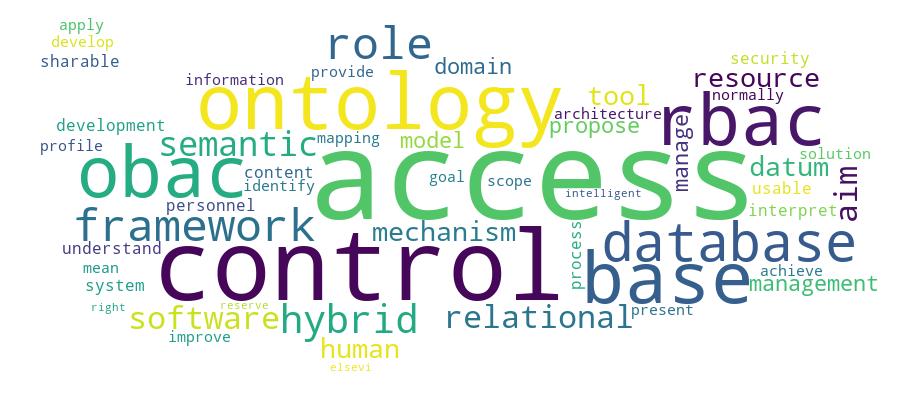
GCRIS Competency Cloud

Scholarly Output Search Results

Now showing 1 - 4 of 4
  • Conference Object
    Development of a Method and a Tool for Hybrid Data Based Access Framework
    (IEEE, 2019) Nuriye Yasemin Alparslan; Murat Komesli; Murat Osman Unalir; Ozgu Can
    Semantic web aims that web contents can be understood and processed by the other software are to be interpreted usable and sharable. Security of information in semantic web is normally provided by access control mechanism. OBAC (Ontology Based Access Control) is a model for accessing ontologies. RBAC (Role Based Access Control) is a model for accessing relational databases. In this study HAC (Hybrid Access Control) is aimed to be applied for mapping of relational database and ontology by means of both OBAC and RBAC together. Access control of roles and profiles are aimed to be managed in HR (Human Resources) domain. To achieve the identified goal a method is proposed and the tool software is developed within the scope of this study. HAC is improved as an access control by using both RBAC and OBAC. A software architecture is presented for the access of framework. Roles are managed in HR domain by using hybrid data and a solution for database management is proposed.
  • Article
    From Arthurian Narratives to MMORPGs: Towards an Ethics of Virtual Ecologies, Kral Arthur Efsanelerinden DÇOÇRYO'lara: Sanal Ekolojilere Etik Yaklasimlar
    (Cyprus International University, 2024) Can Özgü; Özgü, Can
    Virtual spaces in video games depict environments and nature in their most refined form. Comprising entirely of code lines these works directly reflect the creators' vision. Thus the development of visual realism in these spaces under absolute control and supervision can potentially alter players' perceptions of nature. The ultimate goal of these spaces filled with creatures threatening the player's virtual existence is for the player to overcome these threats and be elevated as a result. Virtual reality created with refined nature and hierarchical elements contrasts sharply with the legends of King Arthur and the Knights of the Round Table which portray nature as a chaotic untamed environment with fantastical elements. Represented not only in literary genres like poetry and novels but also adapted into various forms such as series films and video games the nature and environmental perception conveyed by these legends differ significantly from today's understanding of nature and the environment. Despite being separated by centuries Arthurian legends and contemporary digital spaces can be read within Ian Bogost's concept of "unit operations." Using eco-criticism and object-oriented ontology theories in this study I comparatively examined King Arthur legends and Massive Multiplayer Online Role-Playing Games. The aim of the study is to demonstrate how the nature representations specific to the King Arthur legends rejecting a human-centered approach and cultural domestication can serve as a precedent for the construction of nature ethics in virtual spaces in video games. © 2024 Elsevier B.V. All rights reserved.
  • Conference Object
    Development of a Method and a Tool for Hybrid Data Based Access Framework
    (Institute of Electrical and Electronics Engineers Inc., 2019) Nuriye Yasemin Alparslan; Murat Komesli; Murat Osman Unalir; Özgü Can; Can, Ozgu; Alparslan, Nuriye Yasemin; Komesli, Murat; Unalir, Murat Osman
    Semantic web aims that web contents can be understood and processed by the other software are to be interpreted usable and sharable. Security of information in semantic web is normally provided by access control mechanism. OBAC (Ontology Based Access Control) is a model for accessing ontologies. RBAC (Role Based Access Control) is a model for accessing relational databases. In this study HAC (Hybrid Access Control) is aimed to be applied for mapping of relational database and ontology by means of both OBAC and RBAC together. Access control of roles and profiles are aimed to be managed in HR (Human Resources) domain. To achieve the identified goal a method is proposed and the tool software is developed within the scope of this study. HAC is improved as an access control by using both RBAC and OBAC. A software architecture is presented for the access of framework. Roles are managed in HR domain by using hybrid data and a solution for database management is proposed. © 2020 Elsevier B.V. All rights reserved.
  • Article
    Citation - WoS: 1
    Citation - Scopus: 1
    “The Devil in the Mirror: Projections of Desire from Folk Tales to Witcher 3: The Wild Hunt”
    (SAGE Publications Inc., 2024) Can Özgü; Özgü, Can
    Dealing with the Devil is one of most prominent cultural motifs across the history of recorded folk tales. From ancient folk tales to contemporary cultural products the Devil has appeared as an illicitly desirable being. The focal point of dealing with the Devil is that it is instigated by a pre-existent desire to exceed one's capacity determined by their temporal circumstances. In the Christian narrative tradition a deal with the devil occurs over a Manichean undercurrent and ends in the condemnation of the participant or in the devil's humiliation. Pantheistic traditions discombobulate this contract by virtue of the nonexistence of Manichean binaries. This study aims to analyze the prevalence of desire in the deal with the devil motif throughout various tales and how the video game Witcher 3: The Wild Hunt (2015) complicates notions that are often taken for granted in Christian folk tales through its core narrative design. © 2024 Elsevier B.V. All rights reserved.