
Çam, Nezir Yağiz
Loading...
Name Variants
Nezir Yağız Çam
Nezir Yagiz Cam
Nezir Yagiz Cam
Job Title
Araş.Gör.Dr.
Email Address
Main Affiliation
01.01.09.04. Enerji Sistemleri Mühendisliği Bölümü
Status
Current Staff
Website
ORCID ID
Scopus Author ID
Turkish CoHE Profile ID
Google Scholar ID
WoS Researcher ID
Sustainable Development Goals
 1
1NO POVERTY
0
Research Products
 2
2ZERO HUNGER
0
Research Products
 3
3GOOD HEALTH AND WELL-BEING
0
Research Products
 4
4QUALITY EDUCATION
0
Research Products
 5
5GENDER EQUALITY
0
Research Products
 6
6CLEAN WATER AND SANITATION
0
Research Products
 7
7AFFORDABLE AND CLEAN ENERGY
8
Research Products
 8
8DECENT WORK AND ECONOMIC GROWTH
0
Research Products
 9
9INDUSTRY, INNOVATION AND INFRASTRUCTURE
0
Research Products
 10
10REDUCED INEQUALITIES
0
Research Products
 11
11SUSTAINABLE CITIES AND COMMUNITIES
0
Research Products
 12
12RESPONSIBLE CONSUMPTION AND PRODUCTION
1
Research Products
 13
13CLIMATE ACTION
1
Research Products
 14
14LIFE BELOW WATER
0
Research Products
 15
15LIFE ON LAND
0
Research Products
 16
16PEACE, JUSTICE AND STRONG INSTITUTIONS
0
Research Products
 17
17PARTNERSHIPS FOR THE GOALS
0
Research Products

Documents
7
Citations
87
h-index
4

Documents
5
Citations
61

Scholarly Output
9
Articles
9
Views / Downloads
0/0
Supervised MSc Theses
0
Supervised PhD Theses
0
WoS Citation Count
56
Scopus Citation Count
79
Patents
0
Projects
0
WoS Citations per Publication
6.22
Scopus Citations per Publication
8.78
Open Access Source
3
Supervised Theses
0
| Journal | Count |
|---|---|
| Journal of Energy Storage | 4 |
| Solar Energy | 2 |
| Applied Thermal Engineering | 1 |
| International Journal of Thermofluids | 1 |
| Journal of Energy Systems | 1 |
Current Page: 1 / 1
Scopus Quartile Distribution
Quartile distribution chart data is not available
Competency Cloud
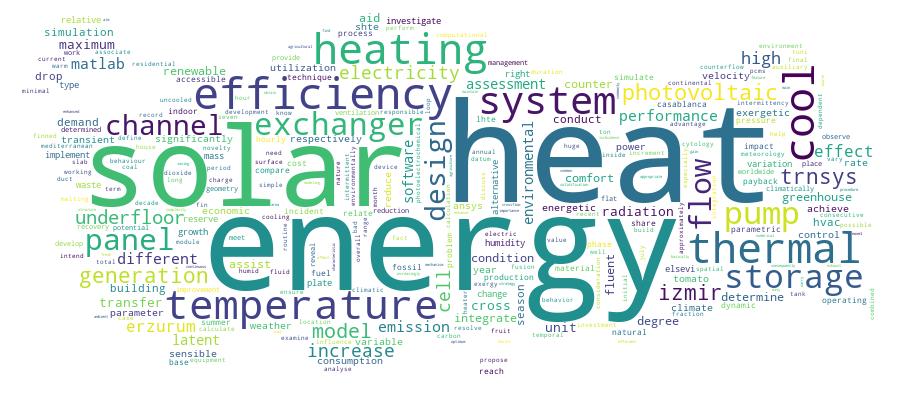
9 results
Scholarly Output Search Results
Now showing 1 - 9 of 9
Article Citation - WoS: 36Citation - Scopus: 42Cooling channel effect on photovoltaic panel energy generation(PERGAMON-ELSEVIER SCIENCE LTD, 2021) Zeynep Ozcan; Miray Gulgun; Ecem Sen; Nezir Yagiz Cam; Levent Bilir; Gulgun, Miray; Sen, Ecem; Ozcan, Zeynep; Bilir, Levent; Cam, Nezir YagizIt is a well-known fact that even though the electricity generation is higher when the solar radiation is high on a photovoltaic panel its efficiency drops as its temperature increases. In this study it is intended to achieve cooling effect using an air duct placed under a photovoltaic panel thereby increase its efficiency. Hourly electricity generation PV efficiency and cell temperature values over a year are calculated using annual temperature and radiation data by using MATLAB and PV Sol software. Maximum cell temperature for the uncooled case is determined as 57.91 degrees C on July 21st at 1p.m. as a result of hourly calculations. The incident solar radiation is 976 W/m(2) when the panel reached its maximum temperature. The PV panel and cooling channel are modelled in ANSYS Fluent software and cooling effect was investigated for different air velocities and air-cooling channel geometries for the hour when maximum cell temperature is reached. Environmental analyses are also made. It is observed that with finned cooling channel it is possible to cool PV temperature more than with the flat cooling channel. Cooling the PV panel from its maximum cell temperature to 39.82 degrees C with 5 m/s air velocity and 82 fins cooling channel is achieved and new PV panel efficiency is recorded as 18.92 %. Environmentally considerations show that the use of solar energy provides the reduction of coal and natural gas-based CO2 emissions as 15 and 8 tons respectively.Article Citation - Scopus: 15An integrated transient model in TRNSYS for thermal management of the tomato growth process in a greenhouse with a PV-aided heat pump-assisted HVAC system(Elsevier B.V., 2024) Nezir Yağız Çam; Mehmet Akif Ezan; Yusuf Bicer; Ezan, Mehmet Akif; Çam, Nezir Yağız; Biçer, YusufGreenhouses are the most common agricultural structures for controlled environment agriculture and it is not easy to control the indoor climate due to the complexity of the heat and mass transfer mechanisms. Therefore numerical models help to simulate the greenhouse indoor environment under various design alternatives obtain the heating and cooling rates and determine the appropriate control strategy. In this study a novel transient thermal model of a greenhouse is developed in MATLAB and implemented in TRNSYS software to simulate the thermal management procedure for the tomato growth process. A PV-aided HVAC system with a heat pump is integrated into the greenhouse to meet the heating/cooling load and maintain the temperature and relative humidity of the indoor ambient within the desired ranges. It is assumed that the greenhouse has three tomato growth seasons annually. The temperature and relative humidity of the indoor air and the heating and cooling rates of the HVAC system are determined and the temperature and relative humidity variations are compared against a greenhouse without an HVAC unit. The simulations are conducted with TRNSYS for four climatically different cities: Izmir Valencia Casablanca and Tunis. The results reveal that the electricity consumption of the heat pump-assisted HVAC system is highest in Izmir with 742230 kWh/year. Besides the highest photovoltaic electricity production is determined in Tunis with 417960 kWh/year. The highest reduction in carbon emissions is determined in Casablanca with 112541.4 kg CO2 eq./year. © 2024 Elsevier B.V. All rights reserved.Article Citation - Scopus: 1Analysis and design of an air to air heat exchanger used in energy recovery systems(Erol Kurt, 2022) Helin Ülgen Elmacioǧlu; Irem Özsevgin; Cennet Kocabiyik; Nezir Yağız Çam; Levent Bilir; Elmacioǧlu, Helin Ülgen; Kocabiyik, Cennet; Özsevgin, Irem; Bilir, Levent; Čam, Nezir YaǧizWith the continuous worldwide energy use increase energy efficiency is gaining high importance. Consequently many methods have been investigated for potential energy savings. One of these methods is the use of heat recovery systems. These systems basically re-use waste heat and reduce energy consumption. Also they are increasingly used to reduce heating and cooling demands of buildings. Their main feature is to provide fresh air to the place which is heated by the exhaust air with the help of a heat exchanger (HEX) working between two different temperature sources. The most commonly used types of heat exchangers in ventilation systems are cross-flow and counter-flow heat exchangers. Cross-flow heat exchangers have a thermal efficiency in the range of 50-75% while counter-flow heat exchangers have 75-95%. Many studies have been carried out to increase the efficiency of this type of heat exchangers. In this study different designs of crossflow and counter-flow exchangers are compared using ANSYS Fluent software. The aim is to determine how the plate surface geometry affects heat transfer and pressure drop. It is aimed to find the optimum design with maximum efficiency high heat transfer and low pressure drop for heat exchangers. As a result it has been observed that thermal efficiency increased from 18% to 60% when changing from cross flow to counter flow in flat plate design while it increased from 25% to 77% in enhanced plate designs. For enhanced designs counter flow heat exchanger is 52% more efficient than cross flow heat exchanger. Also improvements to increase the surface area and turbulence in both flow types have increased heat transfer and thermal efficiency. © 2022 Elsevier B.V. All rights reserved.Article Thermal behavior of a solar-assisted latent heat thermal energy storage unit on the heating season under variable weather conditions(Elsevier Ltd, 2022) Nezir Yağız Çam; Ersin Alptekin; Levent Bilir; Mehmet Akif EzanDue to the fossil-fuel-related climatic problems which got worse in recent decades the worldwide share of renewable energy has significantly increased. Even though solar energy is one of the most accessible renewables it has an intermittent nature throughout the day. Different energy storage techniques are implemented to resolve the intermittency problem and make solar-aided energy accessible when it is needed. Energy use in buildings has a huge share of total energy demand and heating/cooling demands are responsible for most energy consumption in buildings. In this study the performance of a solar-assisted latent heat thermal energy storage (LHTES) unit integrated with a heat pump is investigated during the heating season under variable weather conditions. Phase change materials (PCMs) with different melting temperatures (Tm) and latent heat of fusions (hsf) are studied and parametric simulations are conducted to examine the proposed systems' economic advantage and payback duration. Variable weather conditions are defined in simulations and seven consecutive day analyses are conducted to ensure that results are not dependent on the initial conditions. Results revealed that the PCM with Tm = 35°C and hsf = 240 kJ/kg has a better thermal performance than the other alternatives i.e. Tm = 31°C and 40°C. The integration of the solar-aided LHTES unit with the heat pump increases the COP of the heat pump and the increment varies from 35% to 80% for heating months in Izmir. Such an improvement in COP reduces the operating costs related to the electricity consumption of the heating device significantly and the simple payback period of the combined system is determined to be approximately 13 years in Izmir. © 2022 Elsevier B.V. All rights reserved.Article Citation - WoS: 14Citation - Scopus: 15Thermal behavior of a solar-assisted latent heat thermal energy storage unit on the heating season under variable weather conditions(ELSEVIER, 2022) Nezir Yagiz Cam; Ersin Alptekin; Levent Bilir; Mehmet Akif Ezan; Alptekin, Ersin; Bilir, Levent; Ezan, Mehmet Akif; Cam, Nezir YagizDue to the fossil-fuel-related climatic problems which got worse in recent decades the worldwide share of renewable energy has significantly increased. Even though solar energy is one of the most accessible renewables it has an intermittent nature throughout the day. Different energy storage techniques are implemented to resolve the intermittency problem and make solar-aided energy accessible when it is needed. Energy use in buildings has a huge share of total energy demand and heating/cooling demands are responsible for most energy consumption in buildings. In this study the performance of a solar-assisted latent heat thermal energy storage (LHTES) unit integrated with a heat pump is investigated during the heating season under variable weather conditions. Phase change materials (PCMs) with different melting temperatures (T-m) and latent heat of fusions (h(sf)) are studied and parametric simulations are conducted to examine the proposed systems' economic advantage and payback duration. Variable weather conditions are defined in simulations and seven consecutive day analyses are conducted to ensure that results are not dependent on the initial conditions. Results revealed that the PCM with T-m= 35 degrees C and h(sf) = 240 kJ/kg has a better thermal performance than the other alternatives i.e. T-m = 31 degrees C and 40 degrees C. The integration of the solar-aided LHTES unit with the heat pump increases the COP of the heat pump and the increment varies from 35% to 80% for heating months in Izmir. Such an improvement in COP reduces the operating costs related to the electricity consumption of the heating device significantly and the simple payback period of the combined system is determined to be approximately 13 years in Izmir.Article Citation - WoS: 1Citation - Scopus: 2Modeling of a Solar-Aided Heating and Cooling System with Thermal Energy Storage for a Sustainable Agricultural Greenhouse(Pergamon-Elsevier Science Ltd, 2025) Ghiat, Ikhlas; Ezan, Mehmet Akif; Cam, Nezir Yagiz; Bicer, YusufGreenhouses, a primary feature of sustainable agriculture, necessitate sophisticated climate management due to the intricacies of heat and mass transfer processes. Computational modeling tools are utilized to simulate the microclimate within greenhouses under different design scenarios, determine heating and cooling loads, and ascertain optimal control strategies. The current study develops a novel simulation model of a solar-assisted chiller and heat pump system with a thermal energy storage unit for heating, cooling, and ventilation of a climate-controlled agricultural greenhouse. A comprehensive study of the thermal impact of ventilation control and shade cloth, which are passive air conditioning methods used in greenhouses, is conducted using the inhouse code developed in MATLAB. The greenhouse air conditioning system's energy consumption is reduced from 160,447.9 to 80,540.3 kWh by implementing ventilation control and shade cloth. This also leads to a reduction in carbon emissions from 86,882.5 to 43,612.6 kg-CO2 by 49.8 %.Article Cooling channel effect on photovoltaic panel energy generation(Elsevier Ltd, 2021) Zeynep Özcan; Miray Gülgün; Ecem Sen; Nezir Yağız Çam; Levent BilirIt is a well-known fact that even though the electricity generation is higher when the solar radiation is high on a photovoltaic panel its efficiency drops as its temperature increases. In this study it is intended to achieve cooling effect using an air duct placed under a photovoltaic panel thereby increase its efficiency. Hourly electricity generation PV efficiency and cell temperature values over a year are calculated using annual temperature and radiation data by using MATLAB and PV Sol software. Maximum cell temperature for the uncooled case is determined as 57.91 °C on July 21st at 1p.m. as a result of hourly calculations. The incident solar radiation is 976 W/m2 when the panel reached its maximum temperature. The PV panel and cooling channel are modelled in ANSYS Fluent software and cooling effect was investigated for different air velocities and air-cooling channel geometries for the hour when maximum cell temperature is reached. Environmental analyses are also made. It is observed that with finned cooling channel it is possible to cool PV temperature more than with the flat cooling channel. Cooling the PV panel from its maximum cell temperature to 39.82 °C with 5 m/s air velocity and 82 fins cooling channel is achieved and new PV panel efficiency is recorded as 18.92 %. Environmentally considerations show that the use of solar energy provides the reduction of coal and natural gas-based CO2 emissions as 15 and 8 tons respectively. © 2021 Elsevier B.V. All rights reserved.Article Citation - WoS: 5Citation - Scopus: 4Development of an integrated underfloor heating system model in TRNSYS and performance assessments(Elsevier Ltd, 2024) Okan Gök; Nezir Yağız Çam; Ersin Alptekin; Mehmet Akif Ezan; Aytunç Erek; Gok, Okan; Alptekin, Ersin; Ezan, Mehmet Akif; Erek, Aytunc; Cam, Nezir YagizIn this study a transient model for a solar underfloor heating system with a sensible heat thermal energy storage (SHTES) system to meet the heating demand of a residential building is developed in TRNSYS software. As a novelty in the current model rather than using the built-in modules in the software an in-house MATLAB routine is implemented in TRNSYS to simulate the spatial and temporal variations inside a 2D slab-type SHTES tank. Long-term dynamic simulations are conducted to discuss the influences of the design and working parameters on the (i) energetic and exergetic performances (ii) solar fraction and (iii) CO2 emissions associated with the alternative underfloor heating systems. Parametric analyses are performed for climatically different locations such as Izmir (Csa: Hot-summer Mediterranean climate) and Erzurum (Dfb: Warm-summer humid continental climate). Variations in charging loop mass flow rates have minimal impact on the overall system performance in Izmir and Erzurum compared to other design and working parameters. The highest energy efficiencies of the solar-aided underfloor heating system for Izmir and Erzurum are achieved for a comfort temperature of 20 °C with 32.9 % and 24.6 % respectively. Regarding exergy efficiency the highest was determined as 4.04 % with a 23.5 °C comfort temperature in Izmir and 3.89 % with a comfort temperature of 20 °C in Erzurum. As a final result of the environmental assessments integrating solar SHTES especially with a natural gas-based auxiliary heater significantly reduces CO2 emissions by 99.6 % and 50.0 % in Izmir and Erzurum respectively. © 2024 Elsevier B.V. All rights reserved.Article Development of an integrated underfloor heating system model in TRNSYS and performance assessments(ELSEVIER, 2024) Okan Gok; Nezir Yagiz Cam; Ersin Alptekin; Mehmet Akif Ezan; Aytunc ErekIn this study a transient model for a solar underfloor heating system with a sensible heat thermal energy storage (SHTES) system to meet the heating demand of a residential building is developed in TRNSYS software. As a novelty in the current model rather than using the built-in modules in the software an in-house MATLAB routine is implemented in TRNSYS to simulate the spatial and temporal variations inside a 2D slab-type SHTES tank. Long-term dynamic simulations are conducted to discuss the influences of the design and working parameters on the (i) energetic and exergetic performances (ii) solar fraction and (iii) CO2 emissions associated with the alternative underfloor heating systems. Parametric analyses are performed for climatically different locations such as Izmir (Csa: Hot-summer Mediterranean climate) and Erzurum (Dfb: Warm-summer humid continental climate). Variations in charging loop mass flow rates have minimal impact on the overall system performance in Izmir and Erzurum compared to other design and working parameters. The highest energy efficiencies of the solar-aided underfloor heating system for Izmir and Erzurum are achieved for a comfort temperature of 20 degrees C with 32.9 % and 24.6 % respectively. Regarding exergy efficiency the highest was determined as 4.04 % with a 23.5 degrees C comfort temperature in Izmir and 3.89 % with a comfort temperature of 20 degrees C in Erzurum. As a final result of the environmental assessments integrating solar SHTES especially with a natural gas-based auxiliary heater significantly reduces CO2 emissions by 99.6 % and 50.0 % in Izmir and Erzurum respectively.
